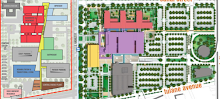
According to VA representatives at the VA Neighborhood Meeting this evening, the structural assessment for Dixie Brewery is complete. It is now in the hands of the State Historic Preservation Office (SHPO).
SHPO has requested a consultation, and the VA is working to set up that consultation, which will focus on the entire building, in the next three weeks. I asked if this was an official consultation under Section 106 (federal law) or just a meeting. I was told it was an official consultation. When asked, VA said that consulting parties under Section 106 were not invited to the consultation.
When pressed, VA would not even give an estimated date for when it would release the assessment to the public (I encourage any Louisiana residents out there to make a public records request upon the Louisiana SHPO to try to obtain the document).
One VA representative on hand did say, when addressing some query, that "...the building did take a lot of water."
And that somewhat ominous note brings up another issue, one that was also addressed this evening: what if Dixie is found to be inadequate for the VA's research facility needs, for whatever reason?
Well, according to the old Memorandum of Understanding that governs (or at least governed) the relationship between the City of New Orleans and the VA for the project (a Nagin-era folly), the VA could look for "replacement acreage." In other words, if Dixie doesn't work...then the City of New Orleans will provide the VA with replacement land. Now that's ominous - especially for the many people who still live between S. Rocheblave and Broad Street, immediately adjacent to the present VA Footprint.
Here's the provision, something I'd call "The Sinister Clause" - and VA, when asked, would not take the option off the table (although since VA has seemingly had the Dixie Brewery property tansferred to itself, from what I know...it's unclear whether that would moot the issue):
Note that the replacement acreage under the agreement would be contiguous to the existing VA Footprint - or within 150 feet.
Someone could also make a public records request upon the City to determine if it has received notice in writing from VA regarding VA's intentions for the Dixie Parcel - or to see if there has been any discussion of replacement acreage that would functionally grow the size of the VA Footprint as we know it, almost certainly resulting in the destruction of something else around the current site.
Tuesday, July 19, 2011
Koepfer House demolished in LSU Footprint
Returning from a funeral this morning, I happened upon the demise of the building at 2101-03 Palmyra, a structure discussed here and here, this morning.
"Let's go get'em" or some other brass band song was on, so I cranked it up and sat back and watched as another great historic home was torn down. It was some strange permutation of a jazz funeral - a sudden need to disconnect.
The Last Camelback
Heavy salvage continued today on the last of the three sister camelbacks on Cleveland Avenue in the LSU Footprint. The crew, which seems to be a Willie White crew, has spent multiple days scavenging a great number of architectural and structural elements from the doomed building.
Off in the background, McDonogh No. 11 commands the largely vacant site.
Labels:
1932-34 Cleveland Avenue,
camelback,
McDonogh No. 11,
salvage,
UMC,
Willie White
Preparation for House Moving in the UMC
Again, don't get your hopes up. While at least five houses in the LSU Footprint are being prepared for moving, it's unclear whether they will actually move. Are lots in place? Has a contract been signed?
Still, for someone who's been pushing for the moving of these houses since a press conference in the LSU Footprint in early October 2010 - and even before that - it is a bit incredible to see some signs. Like the note shown above, which would essentially mean that the entire colorful double shotgun house at 2038-40 Cleveland on the corner of S. Johnson and Cleveland Avenue could move off the site intact (it's roof, too, remains in place for now). Houses in the VA Footprint were cut off at 60 feet for moving purposes in order to navigate around corners.
Monday, July 18, 2011
In the alternative
Should the LSU (UMC) Footprint be entirely cleared in coming months...only to see one of the many obstacles to completion thwart actual construction...the question does arise: well, what do you do with the site?
The state, along with LSU and the UMC Board, as well as the City of New Orleans and various state and federal agencies, has been content to sit back and let the demolition fait accompli play out. Irresponsible demolition and clearance of the site has been the one thing the project has had going for it. Governor Jindal refers to it all the time. The logic is crude and medieval: if we destroy the entire area, they'll have to give us what we want. Would they rather a vacant site?
At one point not long ago, I would have pushed for adaptive reuse of the many historic structures in the site, along with the construction of various infill developments, in an effort to serve the many workers at surrounding institutions. But most of the structures in the site have been destroyed. The city may still end up with a vacant site. And if it does, what could happen with the site?
My suggestion here side-steps the incredibly thorny issue of how the expropriation lawsuits would play out for the more than 200 parcels involved in the UMC site. It's a suggestion made with the knowledge that a very complex property problem would have to be dealt with. But here it is, just in case:
If the UMC is not constructed in the present LSU Footprint, the city, state, and federal government should push the entity now known as BioDistrict New Orleans to reduce its 1,500-acre footprint and concentrate its bioscience facilities and development in the LSU Footprint. Redirecting dense, vertical, urban development to the site would mean the BioDistrict could be much smaller without minimizing whatever economic impact it might generate. And it would help to avoid the neighborhood-level inflammation that has continued for over 9 months, including tensions when the BioDistrict and state legislators refused to honor the Mid-City Neighborhood Organization's request to be let out of the district.
The image at the head of the post shows the BioDistrict boundary in blue. Reducing it down significantly, placing most of it inside the yellow outline that denotes the current UMC site, might be impossible based on various legal hurdles. But I suggest it as part of the broad picture discussion about how to deal with contingencies that may yet arise. The suggestion flows from what some of us having been saying for months: the BioDistrict would avoid many problems if it concentrated its development in the vacant swaths of the CBD and Historic Medical District instead of intruding into historic neighborhoods.
Sunday, July 17, 2011
More on the "Koepfer" House
Recently, I focused in on the corner property at 2101-03 Palmyra, at the corner of S. Johnson Street. Well, a kindly anonymous friend of the blog has provided a treasure trove of additional information about the property and its 19th Century owner, John Koepfer. Diving into the history behind the people associated with this one building helps to give a sense of the true loss that destruction of the historic neighborhood fabric has wrought.
The Estalote family, immigrants from Spain and France, operated a competing corner grocery in the vicinity as early as 1880 (1880 Census, E.D.23, Page 520A, Family #259).
As you can tell from the Koepfer surname, the Lower Mid-City area was once home to many Germans - it's no coincidence that Deutsches Haus sprang up in the area. The information provided below about Mr. Koepfer seems to confirm that the building, used in part by Koepfer as a grocery store, was constructed at about the time of the United States Civil War, if not before. This helps explain the many doors and the overall layout of the building.
At the time the Robinson Atlas was compiled, the section of Square 521 forming the corner of Palmyra and S. Johnson was owned by John Koepfer.
John Koepfer acquired the property from Nicholas Fitsimmons on June 3rd 1861 (COB 87/32). The 1861 New Orleans City Directory lists John Kopfer (sic) as a grocer at the corner of Johnson and Palmyra. Internal Revenue tax assessments provide further proof that John Koepfer operated a business at that location in the mid-1860s. The 1865 tax rolls show him engaged in business in retail and as a dealer at the corner site, although he was charged more in taxes for "liquor" than anything else:
A native of Baden Baden, Germany, John Koepfer immigrated circa 1848, possibly as a result of the failed Revolutions of 1848, and settled in New Orleans. A politically-active Democrat, he was a charter member and officer of the original Johnson Rangers, a Third Ward political organization established in August 1868:
John Koepfer, Sr. died December 6th 1882, at the age of 57, and was buried in Greenwood Cemetery. Both his obituary (Daily Picayune, 7 December 1882) and Greenwood Cemetery interment rolls confirm Koepfer's last residence was at the corner of Palmyra and South Johnson. Koepfer's widow continued the grocery business at that location until her death in early 1896.
Koepfer's son and widow died of Pneumonia within eight days of each other in March 1896 and were laid to rest in Greeenwood Cemetery. John Koepfer, Jr. had been a minor public servant, having served as a clerk in the city's conveyance office (NOCD 1889). At the time of his death, he was employed as Chief Clerk in the city's Personal Tax Bureau office (NOCD 1894).
The Koepfer grocery and residence at the corner of Palmyra and South Johnson was sold at auction in the summer of 1896 (Daily Picayune,12 July 1896 - see below), in conjunction with Regina Gunther Koepfer's succession (CDC 49,304). Regina Gunther Koepfer's estate sold the property to M.S. Estalote (COB 161/783).
The Estalote family, immigrants from Spain and France, operated a competing corner grocery in the vicinity as early as 1880 (1880 Census, E.D.23, Page 520A, Family #259).
UMC troubles noted in New York Times
In an op-ed ominously entitled "Making Murder Count":
An inability to effectively monitor our city’s population has likewise hampered New Orleans’s efforts to plan for our future health care needs, education needs and other essential services. Consultants have found, for example, that a hospital under construction is larger than needed for the number of people who actually live there.
One quibble...the hospital is not under construction. That's a key fact to keep in mind. Jerry Jones with the state specifically has not yet obtained permission to move into the construction phase, as he noted at the UMC Board meeting last week. He must obtain permission from Joint Budget - and that won't happen, from what I understand, until a business plan is presented in September.
Additionally, I don't believe that LSU/state/UMC insistence on a 424-bed hospital stems from a misreading of population estimates at all.
"176 parcels have been cleared, with 58 more slated for demolition"
What are the roots that clutch,
what branches grow
Out of this stony rubbish?
The silhouettes of historic McDonogh No. 11 School and Dixie Brewery were visible Friday beneath the branch of a downed tree near S. Roman Street...across a devastated landscape in the LSU Footprint.
Labels:
allusions,
bad ideas,
demolition,
Dixie Brewery,
LSU/VA Hospital,
McDonogh No. 11,
photos
Last week
A warehouse building along Cleveland Avenue and S. Johnson, part of the former Cox complex of buildings that fronts Canal Street, went down.
Noted
From the Money section of today's Times-Picayune:
New University Medical Center Economic Impact:
The Jefferson Chamber meeting is July 27 at 8:30 a.m. at Crowne Plaza New Orleans Airport, 2829 Williams Blvd., Kenner. To register, visit events calendar at www.JeffersonChamber.org or contact Matt Preuett at 504.835.3880 or matt@jeffersonchamber.org
New University Medical Center Economic Impact:
The Jefferson Chamber meeting is July 27 at 8:30 a.m. at Crowne Plaza New Orleans Airport, 2829 Williams Blvd., Kenner. To register, visit events calendar at www.JeffersonChamber.org or contact Matt Preuett at 504.835.3880 or matt@jeffersonchamber.org
Friday, July 15, 2011
Unnecessary Costs - Because the state went with Lower Mid-City instead of using the Charity building it already owns
$46.3 million - land acquisitions
$4.1 million for legal services related to buying or expropriating the 244 parcels on the Mid-City footprint
$2.6 million on relocation programs, including $721,805 of that on professional services contracts
$284,581 on demolitions
The other costs listed in the Times-Picayune article may or may not have been similar for a retrofit of Charity Hospital.
But the bottom line remains valid: The UMC site, as proposed for Lower Mid-City, has resulted in the project costing much more than it needed to cost. The choice has also significantly delayed the return of care.
The state is missing out on the ability to use historic tax credits in any way by refusing to go into Charity. It has also spent over $50 million more than needed because it chose the Lower Mid-City site as opposed to a viable alternative - at a time when it remains hundreds of millions of dollars short of the funding necessary for the Lower Mid-City option, and when the Charity retrofit would have been less expensive overall.
"The state still does not own two parcels."
That's funny. At the UMC Board meeting yesterday, Jerry Jones with the Office of Facilities Planning and Control said that the state owned all the parcels in the UMC Footprint.
NOTE: Unless these two parcels are the Cox blockhouse property that is staying and one other - at least one property will apparently be used by contractors on site.
Another sign
Interesting:
The LSU AgCenter is planning to declare a state of financial emergency next month, Chancellor Bill Richardson told the LSU Board of Supervisors Friday.
A declaration of “exigency” is the procedural step that allows university officials to lay off tenured employees and cut programs. Richardson said $26 million in direct and indirect budget cuts in more than two years without having the ability to increase tuition as colleges can has led to the crisis.
It's interesting that the AgCenter is facing this crisis...even as the LSU Board of Supervisors spent tens of millions of dollars expropriating properties, and the state spent more on relocating businesses, and engaging in "site preparation" in the LSU Footprint in New Orleans...while the existing Charity Hospital structure, a building that the state still owns, sits vacant.
Labels:
Big Charity,
fiscal responsibility,
land grab,
LSU,
LSU/VA Hospital,
UMC
A real loss in the UMC Footprint
Here's what 2101-03 Palmyra in the LSU (UMC) Footprint looked like until a few days ago.
Note the deep overhanging eave on the south side of the shotgun building:
This creole-inspired building likely dates to before 1880 given a number of architectural details, including the deep south eave, old-style brackets, and the roof lines, visible below. The front portion of the hipped roof is distinct from the portion in the back. It's also a corner building, so the cypress drop siding runs along not just the front facade on Palmyra, but also along the entire side elevation along S. Johnson Street.
From what I recall, Mr. Carl lived here back when the VA site was being cleared, as did an old lady who would sometimes clear weeds along the back fence, all the way up to a point several months ago.
Here's a view of the parcel from the Notarial Archives website. It is part of plate 5 of the Robinson Atlas. Although copyrighted in 1883, it is based on the Braun survey of the late 1870s:
Note that the map shows a building with two distinct roof sections (denoted with blue arrow), indicating that the same structure was standing at that time.
What about Dixie?
So, when is the structural assessment report on Dixie Brewery, key to the building's partial retention in the VA scheme, coming out? At the most recent VA neighborhood meeting, nearly a month ago, it sounded like the report was all but done.
Thursday, July 14, 2011
Perplexed in Pershing Place
Several months ago, a concrete slab was poured in the green grass of Pershing Place (or Billy Goat Park), a small green space at the intersection of S. Galvez, Banks, and Tulane. A bus stop shelter appeared shortly thereafter. I thought it was a bit odd - the park is set to disappear, from what I can tell, for the UMC project.
It was even more odd to see a crew breaking up the concrete yesterday, the bus stop gone (moved across the way at far right?).
The men breaking up the concrete couldn't tell me much at all.
Footprint Flood
Right on the border of the UMC site:
According to police, flooded areas shortly before 4 p.m. included:
Canal Street between Galvez and Roman streets.
According to police, flooded areas shortly before 4 p.m. included:
Canal Street between Galvez and Roman streets.
Times-Pic on UMC Board Meeting
Here.
Note the contradiction in the Board's approach - yes, we'll do an independent study now...but, based on the state's site prep. presentation yesterday, we're going to do the exact same thing LSU and the state have been pushing all along:
UMC Chairman Bobby Yarborough said the new round of consulting conforms to Gov. Bobby Jindal's recent charge for the board to craft an independent plan that cannot be labeled as belonging to LSU or any other interest.
Still, the board is not expected to deviate from the concept of a multibuilding campus -- patient towers, a diagnostics and treatment building, an ambulatory care-medical office building and support facilities -- on the Mid-City footprint, despite a continued push from some planners and activists to build anew inside a gutted Charity shell.
Bottom line: Jerry Jones can beat his chest as much as he wants. There's still a great deal of uncertainty about this project's ability to come to fruition.
"We wanna build what we wanna be and not go back to the past."
What a silly statement. That was Dr. Karen DeSalvo's comment on the proposed UMC at yesterday's UMC Board meeting on behalf of Mayor Landrieu.
As usual, this very un-New Orleans comment either reflects the Mayor's failure to grasp the concept of creating an entirely modern hospital facility inside the sound shell of an existing structure or, more likely, his willful attempt to kill the back-to-Charity move because of some unstated motive that's driving him to be so aggressive. It certainly can't be driven by a push for jobs - because many jobs would be created either way. Perhaps it's a desire for actual control of the Charity building...several months ago, a BioDistrict board meeting did reveal that the City had told the BioDistrict to back off from its interest in the giant structure on Tulane Avenue.
The DeSalvo statement is a bit disingenuous, too, because it implies that somehow the facility's form of care and range of services provided would not be any different from those provided before the storm at Charity Hospital just because of the location. It's been very clear that UMC backers, especially in all their Houston and Birmingham envy, are calling for a different model when it comes to "what's inside" the UMC complex.
Finally, for someone who loves to talk about all the innovation in New Orleans in the post-storm era, it's sad to see the Mayor so gung ho about supporting a very old-school, 1950s-style, scorched earth, "urban renewal" push in Lower Mid-City. The continued state-led destruction of the buildings and neighborhood there touched off in fall of 2010 and has been one of the least innovative things to unfold in the wake of the storm. The outdated urban renewal model has been proven destructive and short-sighted time and time again.
Labels:
Charity Hospital,
healthcare,
Karen DeSalvo,
UMC,
urban renewal
Wednesday, July 13, 2011
I'm not holding my breath...
...but this is the first concrete sign that a few houses in the LSU Footprint may yet move off the site.
Yesterday, I had snuffed out the last glimmers of hope that anything would ever be moved. But one of the houses that looked like it was en route to demolition, was instead braced and chopped off at 60 feet today when I arrived - a sign, if the analogous prep process in the VA site is an indicator, that moving may occur.
And roofs, too, are still intact on the three houses (two on Cleveland Avenue and one on S. Galvez) that were being braced and chopped at 60 feet. I've been recommending that for months to various figures involved, and it would go a long way toward preventing problems with the buildings in their destination lots.
But that's the biggest issue - destination lots. Where are they? Do they exist? If they don't, then even these tangible preparatory steps may be for naught. And we need to know if an actual contract for moving has been signed.
McDonogh No. 11 - RFP issued today calling for bids to relocate structure
Here's what appeared in the Times-Picayune today:
McDonogh No. 11 School Relocation University Medical Center New Orleans, Louisiana PROJECT NUMBER: 19-610-06B-04, Part 43 Complete Bidding Documents for this project are available in electronic form. They may be obtained without charge and without deposit from www.aeplans.com. Printed copies are not available from the Procurement Provider but arrangements can be made to obtain them through most reprographic firms. Plan holders are responsible for their own reproduction costs. Questions about this procedure shall be directed to the Procurement Provider at: Jacobs 1824 Palmyra Street New Orleans, LA 70112 Telephone: 318-794-2070 Fax: 504-837-5924 E-mail: robert.mayard@jacobs.com
This is a good step forward on the state's part - especially because the school was set to be demolished until an advocacy push a few months ago. OPSB no longer owns the school, but the RFP is still functionally meaningless if:
- The destination site in the 2900 block of Tulane Avenue is not actually procured.
- The funding for the move is not airtight
- The various obstacles along the route up Tulane Avenue cannot be cleared in a timely fashion
I hope all those issues have been or will soon be resolved. I'm also wondering what part of the building's lower floor will be removed in the process.
Tuesday, July 12, 2011
Needless, Senseless, Heartless Destruction
A friend sent this shot from today...likely the beginning of the end for a fantastic 3-bay shotgun on S. Galvez Street.
I would like to fire off a volley of choice words to all those complicit in the UMC plan, all those who have caused the mass demolition that continues to destroy a neighborhood in a national historic district when less destructive alternatives abound.
But I won't. I'll simply lay out the stark realities for the thousandth time:
- The UMC does not have the money to build the proposed hospital. There is still a gap of over $400 million in necessary financing and there's no clear indication of how that will be overcome.
- The UMC is now saying that the entire hospital complex design may have to be re-worked.
- The pre-application for HUD mortgage insurance, which may have overcome the gap, has been withdrawn, likely due to the reality that HUD would never approve it.
- The UMC still does not have a business plan in place and won't have one until at least September.
- There are over a hundred lawsuits regarding property expropriations (government takings) underway.
- It's unclear if the arrangement with the UMC Board as the private entity end-user of the expropriated lands will even be found legal.
- It is unclear how the operating expenses of the proposed hospital (estimated at over $100 million annually, plus ramp up costs and offset for legacy debts) will be paid for at this point.
- There are no plans for the vacant Charity Hospital and former VA Hospital complexes in the CBD and various developing parties have actively worked to cut out public participation in the adaptive reuse process.
- Not a single usable, renovated, historic building has been moved off the site.
- As has been clear from the very beginning, the UMC as proposed does not need anywhere near the entire 37-acre site that it continues to destroy.
Somehow, the facts have absolutely no traction in this fight, though, I've found.
Gone
The pink, off-set Craftsman house at 1716 Cleveland, which had been in use as an office until recently, is no more. There was no reason it needed to be demolished. The area in which is stands is not set to be used by any part of the UMC complex at any point in the foreseeable future, if at all.
Labels:
1716 Cleveland Avenue,
bad ideas,
business,
demolition,
pink,
waste
Subscribe to:
Posts (Atom)