Showing posts with label Mid-City National Register Historic District. Show all posts
Friday, August 26, 2011
"Modular Grid Modern" - and Mid-City Historic District Expansion
Recently, Crescent Growth Capital, the entity that's redeveloping the former Lindy Boggs or Mercy Hospital site near the end of Bayou St. John, proposed an expansion of the period of significance for the Mid-City National Register Historic District. It also proposed boundary changes.
The period of significance, key for obtaining historic tax credits, is proposed for extension to include the period of 1943-1961 - which would sweep in more Mid-Century Modern buildings, like the LSU Footprint building on Canal Street shown above. It was pictured in Crescent Growth's Baton Rouge presentation as an example of Modular Grid Modern, one of the styles that would be eligible for the National Register under the expanded concept of the district. The building, to my knowledge, is still set to be demolished.
The presentation also acknowledged two small reductions in the district due to new infill housing being built by Providence Community Housing, along with "a larger contraction" due to the destruction wrought by the LSU/VA project, which largely fell within the Mid-City District.
In total, the numbers of contributing historic properties in the district have dropped since the last survey years ago, falling from 3,811 structures to 3,567 structures. In the non-contributing department, there are now 539 structures, down from 678.
The proposed change to the district also seeks to sweep in industrial buildings, such as the brick warehouse and shop buildings along the former Carondelet Canal, now the site of the proposed Lafitte Greenway.
The National Register of Historic Places will ultimately have to decide on whether or not it will accept the proposed changes.
Tuesday, August 9, 2011
Update on Mid-City Rehab Grant Rollout
Last evening, Cynthia Steward from the State Historic Preservation Office rolled out the new Mid-City Rehabilitation Grant program.
The presentation, given at the Mid-City Neighborhood Organization meeting, was largely informational and uneventful. A good crowd was in attendance, however, including a few former LSU/VA footprint residents who have since relocated to the greater Mid-City area. Several residents from the area immediately above the VA Footprint were also on hand.
A number of questions emerged at the end. One of the key points about the grant program: it's a reimbursement grant, so property owners will have to make expenditures before being reimbursed for approved work. Reimbursement for various stages is expected to take about 1 month.
Work will also be limited to exterior rehabilitation, and some Mid-City residents whose properties do not fall within the technical boundaries of the national historic district will not be eligible.
As one Mid-City resident noted after the presentation, "Finally, something good that has come out of this whole thing." She mentioned the possibility of obtaining funding for repair of her family's porch.
Here's more from the Times-Picayune, including a helpful map of the eligible district.
The presentation, given at the Mid-City Neighborhood Organization meeting, was largely informational and uneventful. A good crowd was in attendance, however, including a few former LSU/VA footprint residents who have since relocated to the greater Mid-City area. Several residents from the area immediately above the VA Footprint were also on hand.
A number of questions emerged at the end. One of the key points about the grant program: it's a reimbursement grant, so property owners will have to make expenditures before being reimbursed for approved work. Reimbursement for various stages is expected to take about 1 month.
Work will also be limited to exterior rehabilitation, and some Mid-City residents whose properties do not fall within the technical boundaries of the national historic district will not be eligible.
As one Mid-City resident noted after the presentation, "Finally, something good that has come out of this whole thing." She mentioned the possibility of obtaining funding for repair of her family's porch.
Here's more from the Times-Picayune, including a helpful map of the eligible district.
Wednesday, August 3, 2011
Finalized Details on Mid-City Mitigation Grant Program
Here, via the Louisiana Division of Historic Preservation.
The full roll-out of the program is set for the August 8, 2011 Mid-City Neighborhood Organization meeting:
August 8, 2011
6:30 PM
Grace Episcopal Church
3700 Canal Street
The program is designed to award rehabilitation grants to owners of historic properties in the Mid-City National Register Historic District.
As I noted in my earlier post providing the first public details of the grant, the program was set up as part of the Programmatic Agreement that governs the LSU/VA project.
The full roll-out of the program is set for the August 8, 2011 Mid-City Neighborhood Organization meeting:
August 8, 2011
6:30 PM
Grace Episcopal Church
3700 Canal Street
The program is designed to award rehabilitation grants to owners of historic properties in the Mid-City National Register Historic District.
As I noted in my earlier post providing the first public details of the grant, the program was set up as part of the Programmatic Agreement that governs the LSU/VA project.
Wednesday, July 20, 2011
Mid-City Mitigation Grant Program unveiled last night
Last evening, with two security guards outside the doors of the First Pentecostal Church's meeting hall on Canal Street (brought in by VA contractor Clark/McCarthy), the VA held its monthly neighborhood meeting with residents affected by the project.
Representatives of the State Historic Preservation Office were on hand, based on a request at the last meeting, and they shared the outlines of a rehabilitation grant program for historic buildings in the Mid-City National Register Historic District here in New Orleans (here's a map that gives some rough idea of the district, LSU/VA site is shown in red). The program is being implemented in compliance with the Progammatic Agreement that governs the LSU/VA site preparation.
While the official unveiling of the grant program will take place at the August 8, 2011 meeting of the Mid-City Neighborhood Organization, here are the basic, tentative details of the grant program as laid out last evening:
- The total pot of funding equals $1.4 million, made up of contributions from the VA, City of New Orleans, and State of Louisiana
- The total amount of funding that will comprise grant awards is approximately $1 million; some of the funding is for administrative overhead, some has gone to help with funding rehab of moved VA houses in the Mid-City district
- The cap on individual grants to property owners will be $20,000 - the amount awarded can be any amount equal to or lower than that
- The grants will be available to any property owners with contributing historic properties in the Mid-City National Register District, but the district will be tiered into three areas: the area below Broad nearest to the hospitals site, the area between Broad and Carrollton, and the area above Carrollton farthest from the hospitals site.
- A panel of reviewers, seemingly SHPO staff, will review applications and give preference based on a variety of factors including which tier the applicant's property is located in (preference to those closest to and most affected by the LSU/VA hospital project). It is not clear whether the panel's deliberations will be open to the public or open for public comment.
- Owners will need to provide a scope of work with an application
- Applications will be due on October 14, 2011
- Awards will start to trickle out in about December 2011
- Owners of historic properties that are not contributing due to a building's disrepair will likely be able to apply for funding for repairs that would result in the building become contributing once again
- It sounds like the "first zone" below Broad Street will receive flyers about the grant via a door-to-door walk around, which is good to hear
- The grant will not be a matching grant; owners are welcome to match the grant amount, but they are in no way required to put up funding to get funding
- SHPO staff will hold a grant workshop for residents on August 23 and may host another at some point in September
Here are the provisions in the PA regarding the mitigation fund and grant program (which outline the amount contributed by the various parties):
Representatives of the State Historic Preservation Office were on hand, based on a request at the last meeting, and they shared the outlines of a rehabilitation grant program for historic buildings in the Mid-City National Register Historic District here in New Orleans (here's a map that gives some rough idea of the district, LSU/VA site is shown in red). The program is being implemented in compliance with the Progammatic Agreement that governs the LSU/VA site preparation.
While the official unveiling of the grant program will take place at the August 8, 2011 meeting of the Mid-City Neighborhood Organization, here are the basic, tentative details of the grant program as laid out last evening:
- The total pot of funding equals $1.4 million, made up of contributions from the VA, City of New Orleans, and State of Louisiana
- The total amount of funding that will comprise grant awards is approximately $1 million; some of the funding is for administrative overhead, some has gone to help with funding rehab of moved VA houses in the Mid-City district
- The cap on individual grants to property owners will be $20,000 - the amount awarded can be any amount equal to or lower than that
- The grants will be available to any property owners with contributing historic properties in the Mid-City National Register District, but the district will be tiered into three areas: the area below Broad nearest to the hospitals site, the area between Broad and Carrollton, and the area above Carrollton farthest from the hospitals site.
- A panel of reviewers, seemingly SHPO staff, will review applications and give preference based on a variety of factors including which tier the applicant's property is located in (preference to those closest to and most affected by the LSU/VA hospital project). It is not clear whether the panel's deliberations will be open to the public or open for public comment.
- Owners will need to provide a scope of work with an application
- Applications will be due on October 14, 2011
- Awards will start to trickle out in about December 2011
- Owners of historic properties that are not contributing due to a building's disrepair will likely be able to apply for funding for repairs that would result in the building become contributing once again
- It sounds like the "first zone" below Broad Street will receive flyers about the grant via a door-to-door walk around, which is good to hear
- The grant will not be a matching grant; owners are welcome to match the grant amount, but they are in no way required to put up funding to get funding
- SHPO staff will hold a grant workshop for residents on August 23 and may host another at some point in September
Here are the provisions in the PA regarding the mitigation fund and grant program (which outline the amount contributed by the various parties):
Tuesday, July 19, 2011
Koepfer House demolished in LSU Footprint
Returning from a funeral this morning, I happened upon the demise of the building at 2101-03 Palmyra, a structure discussed here and here, this morning.
"Let's go get'em" or some other brass band song was on, so I cranked it up and sat back and watched as another great historic home was torn down. It was some strange permutation of a jazz funeral - a sudden need to disconnect.
Friday, January 28, 2011
Ms. Ella and her Husband, or Draining the Cultural Marsh
Last evening, I went with some friends to see Ms. Ella and her husband, a native New Orleanian who "masks Indian." He masked with the Yellow Pocahontas, one of the downtown tribes, and now he does so individually on Mardi Gras day.
But Ms. Ella and her husband are being displaced, like hundreds of other New Orleans, from their neighborhood. They live in the LSU Footprint. They're being forced out - for a hospital project that does not even have its funding in place.
As I walked into the front room of the couple's half-shotgun, the ostentatious scarlet suit, resplendant with its ornate hand-crafted beadwork, dominated the space, where Ms. Ella was taking down photos and certificates from the walls, packing them up in green tubs.
The couple, as cheerful and hospitable as they were, were clearly a bit saddened by the need to leave their home. Ms. Ella noted that after so much uncertainty for so long, she's now resigned to the move. She explained how houses all around her house had been demolished in recent weeks. The couple is now looking at a move to a place on Castiglione near the Fairgrounds, over a mile away.
As I took some iPhone photos under the lights and listened to the conversation, I couldn't help but feel the deep sense of loss that circled the impending move. State actions forcing these good people out of their home are wrong in large part because they're unnecessary. And they're emblematic of the problem of saying an area is blighted and acting as if it has no value, National Register District or not.
Razing the area in the VA and LSU Footprints is, when you start to go house by house, very much a draining of the city's incomparably rich cultural marsh. The architecture of homes like Ms. Ella's classic 1870s shotgun is enough of a loss. But it cannot be denied that the culture bearers themselves are also being displaced to make way for surface level parking lots that may or may not materialize.
Tuesday, December 7, 2010
Houses of Steel - Unmoved
In the Lower Mid-City neighborhood outside of the Footprint, a place where moved houses are under rehabilitation along Bienville and other streets, a series of steel-frame houses are also under construction (and have been in some areas closer to Jeff Davis for months).
As someone pointed out to me, it's interesting to see these homes under construction as part of a large, concentrated infill effort - when there are still numerous homes available to be moved off the LSU Footprint...that could do the trick in the historic neighborhood just as well.
Tuesday, November 16, 2010
Right...but not in Lower Mid-City
"Signposts in a Strange Land" features a number of New Orleans writers discussing the city in the wake of Katrina. While they make some excellent points, the destruction of Lower Mid-City stands out as a key - and strangely unmentioned - exception to a number of the broad positive themes:
Sure, but even large swaths of a National Register Historic District here in New Orleans are being razed as we speak.
Great - but when the New Orleans City Council passes an ordinance that bars a neighborhood from even making repairs to homes as it struggles to recover from Katrina...it's difficult for organic recovery to take hold. Government, in Lower Mid-City, created a self-fulfilling prophecy of neighborhood failure to serve its purposes.
Joseph J. DeSalvo: New Orleans still has its architectural heritage while cities like Houston and Dallas have destroyed theirs in the name of modernization and progress. What those those cities have now is a complete lack of charming visual symbols of their history. They have only uninteresting concrete monuments to making money.
Sure, but even large swaths of a National Register Historic District here in New Orleans are being razed as we speak.
It has been the strength of these neighborhoods and the resilience of their people that have fueled a remarkable recovery in the wake of the worst man-made disaster in American history, Hurricane Katrina. New Orleans endured a terrible ordeal as a result of Katrina. Most cities would not have been able to cope as New Orleanians have coped because they do not possess the backbone of strong neighborhoods, each with its unique cultural identity and each with a special pride of neighborhood that creates strong bonds between the residents.
Great - but when the New Orleans City Council passes an ordinance that bars a neighborhood from even making repairs to homes as it struggles to recover from Katrina...it's difficult for organic recovery to take hold. Government, in Lower Mid-City, created a self-fulfilling prophecy of neighborhood failure to serve its purposes.
Monday, September 27, 2010
A Sense of the Senselessness
One of the key things to keep in mind when assessing the LSU/VA Hospitals project is that the site is located squarely within the Mid-City National Register Historic District. That's not a mere local historic district. It's a nationally recognized district - one that highlights the fact that the historic architecture in the district is important not only to the city, but the entire country.
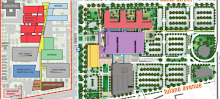
The map above shows you the rough outline of The Footprint superimposed against the backdrop of the Historic District. Here's the original of the map courtesy of the PRC.
It's also important to remember that the design of the proposed hospitals is very much sprawling suburban in style - the buildings do not rise more than about 7 stories high. They also feature, especially on the LSU side, acres of surface parking lot. They would look appropriate in, say...Iowa City. But not in the heart of New Orleans.
Taken together, it's not difficult to see the senselessness of the plan. Not only is the site unfortunate, but the plans by LSU and the VA make it all the more unfortunate because they fail to do all they can to minimize their impact on the city, its cultural legacy, and its historic street fabric - the thing that makes the city different from every other American city and the reason we have a National Register Historic District in the first place.
Subscribe to:
Posts (Atom)