Showing posts with label destruction. Show all posts
Thursday, September 1, 2011
Say farewell to Schadler
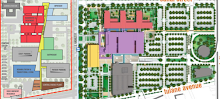
The modernist "Miracle Mile" building, known as the Schadler Building, that housed Southern Electronics began to fall along Tulane Avenue today in the LSU Footprint.
What will take its place? Either a second parking garage - that may or may not get built, as I've outlined (and if it is built, it would ironic seeing as an existing parking structure in the site is still seemingly slated to be imploded along with the old Grand Palace Hotel in about November). If not a parking garage, the original plan called for surface parking. Or it might be lovely greenspace, aka nothing.
Monday, August 29, 2011
Palmyra Street, Six Years After Katrina
To paraphrase Tacitus:
To ravage...to usurp under false titles without funds, they call progress; and where they make a desert, they call it development.
Today, instead of a functioning University Medical Center humming along in the sturdy shell of the former Charity Hospital building, there still isn't even a business plan for the UMC proposed for Lower Mid-City. Nor is there adequate financing in place to build the first phase of the hospital.
There is, however, a largely destroyed swath of the city standing increasingly vacant between Canal, Tulane, S. Galvez, and Claiborne.
If the State of Louisiana, LSU, UMC, City of New Orleans and various federal agencies had pursued the retrofit of Charity three years ago, we could have had a state-of-the-art hospital in place today - and it would have been less expensive (the state has the money onhand to realize the Charity option at present).
Instead, there are no signs that the UMC Board has even considered the Charity option, and is instead bulling forward with the disastrous Lower Mid-City site out of embarrassment.
Labels:
allusions,
anniversary,
destruction,
Hurricane Katrina,
LSU,
Palmyra Street,
street grid,
Tacitus,
UMC,
UMC Board
Friday, August 26, 2011
"Modular Grid Modern" - and Mid-City Historic District Expansion
Recently, Crescent Growth Capital, the entity that's redeveloping the former Lindy Boggs or Mercy Hospital site near the end of Bayou St. John, proposed an expansion of the period of significance for the Mid-City National Register Historic District. It also proposed boundary changes.
The period of significance, key for obtaining historic tax credits, is proposed for extension to include the period of 1943-1961 - which would sweep in more Mid-Century Modern buildings, like the LSU Footprint building on Canal Street shown above. It was pictured in Crescent Growth's Baton Rouge presentation as an example of Modular Grid Modern, one of the styles that would be eligible for the National Register under the expanded concept of the district. The building, to my knowledge, is still set to be demolished.
The presentation also acknowledged two small reductions in the district due to new infill housing being built by Providence Community Housing, along with "a larger contraction" due to the destruction wrought by the LSU/VA project, which largely fell within the Mid-City District.
In total, the numbers of contributing historic properties in the district have dropped since the last survey years ago, falling from 3,811 structures to 3,567 structures. In the non-contributing department, there are now 539 structures, down from 678.
The proposed change to the district also seeks to sweep in industrial buildings, such as the brick warehouse and shop buildings along the former Carondelet Canal, now the site of the proposed Lafitte Greenway.
The National Register of Historic Places will ultimately have to decide on whether or not it will accept the proposed changes.
Monday, August 1, 2011
Howl
...for it is laid waste, so that there is no house, no entering in...
The UMC and VA Hospital footprints in New Orleans on August 1, 2011, looking lakeward from the CBD. Note the number of structures that remain in the UMC site in the midground. Note, too, the stark vacancy of the VA site compared to the dense neighborhood around it - the same urban fabric that existed there one year ago.
Labels:
allusions,
CBD,
destruction,
LSU/VA Hospital,
New Orleans,
photos,
views
Wednesday, July 20, 2011
Google Maps starts to cross out the VA Footprint neighborhood
A friend sent along this image, noting the shift. While a few ghost buildings survive along Tulane Avenue and S. Galvez on the map alone, the streets are shown as gone, as are most of the buildings.
Here's a look at just a few selected VA Footprint screenshots from GoogleMaps - before the change, back when it was dense with historic houses:
Strangely, despite the change in the street map as shown in the first map, the satellite images of the area on Google Maps still shows all the houses intact.
Labels:
change,
destruction,
Google maps,
street grid,
VA hospital
Thursday, July 7, 2011
Tree Treatment
Hurricane Katrina devastated the extensive, mature tree canopy of New Orleans. An estimated 100,000 trees were lost in the city as a result of Katrina and Rita together, damaging or eliminating at least 70% of the city's tree canopy.
Thus, it was somewhat depressing to watch crews chop down numerous large, mature live oaks and other trees in the VA Footprint.
And now, workers continue to chop down trees in the LSU Footprint...even in areas that won't necessarily be built upon in the first phase of construction (and it's unclear whether a second phase will ever even come into being - the first phase is uncertain enough). The photo above shows a swath of downed trees that fell to the machinery yesterday.
Conversely, the photo at the top of the post shows extra measures being taken with the remaining live oaks in the VA Footprint. The tree guards were installed in recent weeks to prevent damage to the trees as construction gets underway. I must say that Clark/McCarthy, the partnership that oversees actual construction in the VA Footprint, now that the VA itself controls the site, has shown itself to be more conscientious in its efforts to head off and mollify concerns than just about any other contractor that I've encountered inside the footprint. It's not only the partnership's comments at VA neighborhood meetings, but also in some of its tangible efforts at follow through.
That's my impression from limited experience, but it's worth noting. It's proof that, while the terrible site selection likely won't be reversed, being smart about some of the details of how to proceed with a highly charged, controversial project can impact the level of inflamed public opposition.
Labels:
Clark/McCarthy,
destruction,
Hurricane Katrina,
live oaks,
tree canopy,
trees,
UMC,
VA hospital
Wednesday, March 9, 2011
Update on the VA Hospital Footprint
A few notes to catch you up:
+ Late last week, the final three houses were moved off the VA Hospital Footprint. The site has been entirely cleared except for those structures that will remain as part of the medical center complex (unless the Dixie Brewery tower is found to be not structurally sound, I suppose).
+ The Dixie Brewery has been fenced for some time now. From what I know, the building was actually expropriated by the LSU Board of Supervisors over a week ago on Friday, February 25. I'm still trying to confirm that fact. But it appears to coincide with the fencing, and it would mean that the VA can now begin to assess the structure for stability - which will ultimately determine the fate of the iconic building. I'm not certain of the legal status of the property in part because the owners apparently filed a legal motion pre-emptively before the state expropriated.
+ The S.W. Green Mansion has been shifted into its final position, twisting a bit from the diagonal position it had when if first moved across S. Rocheblave. It fits! And it looks rather nice standing amidst the live oaks.
+ Parts of Banks Street have been torn up above S. Rocheblave Street. How much more will go? I hope this only part of temporary work on the intersection.
As with so many aspects of the LSU/VA hospitals project, nobody from the developing parties has reached out to explain what's going on. I cannot think of a single time in the past two years that the developing parties have reached out proactively to this blog to provide factual information and defuse potential criticism. It's been a major failing of the project - an inability or unwillingness to engage with online media.
+ Additionally, the 2500 and 2600 blocks of Cleveland Avenue appear to be completed, at long last - at least four months after construction started.
+ The lakeside lane of S. Galvez Street is finally open in full again after being closed since about last summer. The lane was closed at Canal for the past several months despite the lack of any real impediments to traffic.
Thursday, February 3, 2011
An Open Note to HUD Secretary Shaun Donovan as he visits New Orleans today
Dear Secretary Donovan,
As you visit New Orleans today, I hope you'll take a moment away from your time mingling with the BioDistrict staff to visit Lower Mid-City. There, you'll see the true urban devastation that HUD has wrought in a National Register Historic District, in a dense, mixed neighborhood that was rebuilding after Hurricane Katrina. Along with other government entities, HUD helped to finance the project.
I also hope you'll finally address the extensive HUD administrative complaint about the agency's involvement in the LSU/VA project. It was filed by local attorney Mary Howell months ago, and, for all intents and purposes, it has effectively been negated by sheer inaction.
I hope, too, that your visit includes a tour of the over 20 structures demolished in the site of the proposed UMC Hospital despite inadequate financing, especially that one that was demolished after the UMC Board's own consultant provided it and the state's project officials with notice that additional site preparation moves would jeopardize HUD mortgage insurance. Take a look at the incredibly poor UMC design, which does not make any effort to design around historic buildings like the beautiful McDonogh No. 11 School, which shows that the footprint for the proposed hospital is excessive.
You said in August of 2010, writing about the Gulf Coast recovery, that "the Obama Administration is committed to doing things differently in the Gulf." Differently than what? HUD's involvement in the LSU/VA Hospital affair has shown the Obama Administration to be no different than the misguided "urban renewal" advocates of the 1950s and 1960s. Displacing over 500 residents by supporting a project that did not require the destruction of 67 acres of land is the antithesis of sound housing policy. Helping major institutional tenants vacate the historic downtown to do just that is the antithesis of good urban policy. HUD's support of this hospitals project is without a doubt a stain upon its reputation.
Photo courtesy of Sandra Stokes.
Go and see the HUD-funded moonscape in Lower Mid-City. And ask to see the BioDistrict's "consolidated scheme" map which envisions the pocket historic neighborhood across Tulane Avenue along Gravier Street getting destroyed in much the same way. Ask the BioDistrict why it needs 1,500 acres of historic cityscape.
HUD and the Obama Administration should be doing things differently. But unfortunately, that very clearly hasn't been the case.
Tuesday, January 4, 2011
Night Moves and A Walk Inside the Footprint
Late this afternoon, I walked up Palmyra Street with my friend Sandra, heading toward Outer Banks Bar from S. Galvez Street.
It was the last time, it turns out.
I passed the seemingly vacant houses where Ruth Sanderson, Gaynell, and Robert Rogers once lived. I passed the vacancies where Kevin and Bobby, Barry, and the Monleys used to live. James was still haunting the bar itself; a few cars showed that some patrons remained. Greg Guth, who owns the bar building and continues to fight to defend his legal rights, was just heading out.
Off to our left, crews continued to pick up debris from more mature live oak trees that were chopped down today along what used to be Banks Street.
After we circled around, a police officer watching us for much of the time, we walked through the LSU Footprint where crews were just finishing after moving into another house on Cleveland Avenue.
The sun was going down, highlighting the sizable banner draped on an existing LSU building in the LSU Footprint. Very appropriately, it noted that we were wandering "Where The Unusual Occurs":
Around the block, the gate to the grounds of the now-vacant McDonogh No. 11 School, where Priestley Charter School students were recently forced to move to modular units on Almonaster Avenue over the holidays, was open.
Returning to S. Galvez, we saw that workers had moved the Road Closed signs to the opening of Palmyra. An excavator, off in the distance, began to tear up large patches of street. A worker arrived to turn on the generator-powered floodlight at the spot where the demolition was getting underway in the middle of one of the last stretches of street in the VA Hospital Footprint.
Interesting, I thought...starting at 5:00 p.m. as darkness falls.
Mr. Roy, stopping by to chat as he often does, shook his head as he surveyed the latest scene. "You can't fight the federal government," he said.
Labels:
demolition,
destruction,
live oaks,
LSU,
McDonogh No. 11,
Outer Banks
Monday, January 3, 2011
Wednesday, December 15, 2010
Yes, Indeed
"The new campus will respect our neighborhoods, authentically reflect the culture of the region"
- VA on its Project Legacy in New Orleans
I don't expect more from the federal government, but I do demand more - a more intelligent and respectful approach to major projects like this one.
The End of Banks Street
The reverberations of equipment breaking pavement echoed across the vacant VA Hospital Footprint this afternoon.
Banks Street, that great oak-lined avenue, was being broken at various points below S. Rocheblave. The photo above shows the heavy equipment at work near the Dixie Brewery.
Down at S. Galvez, the street was simply gone.
It was difficult to fathom.
Labels:
Banks Street,
bulldozer,
demolition,
destruction,
Dixie Brewery,
live oaks,
street grid,
VA hospital
Tuesday, September 28, 2010
Monday, September 27, 2010
A Sense of the Senselessness
One of the key things to keep in mind when assessing the LSU/VA Hospitals project is that the site is located squarely within the Mid-City National Register Historic District. That's not a mere local historic district. It's a nationally recognized district - one that highlights the fact that the historic architecture in the district is important not only to the city, but the entire country.
The map above shows you the rough outline of The Footprint superimposed against the backdrop of the Historic District. Here's the original of the map courtesy of the PRC.
It's also important to remember that the design of the proposed hospitals is very much sprawling suburban in style - the buildings do not rise more than about 7 stories high. They also feature, especially on the LSU side, acres of surface parking lot. They would look appropriate in, say...Iowa City. But not in the heart of New Orleans.
Taken together, it's not difficult to see the senselessness of the plan. Not only is the site unfortunate, but the plans by LSU and the VA make it all the more unfortunate because they fail to do all they can to minimize their impact on the city, its cultural legacy, and its historic street fabric - the thing that makes the city different from every other American city and the reason we have a National Register Historic District in the first place.
Subscribe to:
Posts (Atom)