Wednesday, August 10, 2011
A Review of the June 2011 Jacobs Report on the UMC Site
Here's the full document via the state's DOA site.
$17 million has been moved from the Contingency line item to establish a budget line item for escalation. Further delay will result in additional escalation at the rate of $1.5 million per month. The Utility Building budget has been moved into the AFC at $35 million
And one of the elephants in the room, budget uncertainty for the overall UMC project, is hinted at obliquely:
"Budget refinement is ongoing"
As far as control of site properties go, the state says it has obtained title to all 242 parcels, although 2 offers are still being considered (seemingly for "critical activity" properties "LSU435 LSU-43"). There are also a few specific notes about things that were supposed to happen in July:
The Notice to Proceed for the abatement and demolition of the Pallas Hotel should be issued the week of July 18th
.
BOH is scheduled to start relocating homes in early July
Issues with differences in the elevation of the VAMC and UMC sites at S. Galvez are also noted:
The City issued road profiles for review by the State in determining the resolution for the elevation difference between the UMC and VAMC sites at Galvez Street. Upon completion of the review follow-up meetings will be scheduled.
What are the overall issues and concerns raised? These - mostly about delay, funding, and the nettlesome high voltage power line that crosses the site:
● The Master Schedule has been adjusted to reflect the impacts of
the CM delivery approval, funding requirements, site
surcharge/wicking requirements, and Clerk’s Office of the Civil
District Court computer problems.
● The Financial Feasibility Study is still being developed as part of
the HUD requirements and is critical to funding the full GMP.
● Construction price escalation impact to the AFC budget due to
delays.
● Impact of medical equipment and utility building costs on the
overall program budget.
● The proposed route for the relocation of the 230kV line was
walked with Entergy on May 11
th
. A general agreement was
reached to locate the poles in the tree line within the public rightof-way. Details are being worked out.
● A schedule delay exists between Entergy’s proposed duration of
the installation of the 230kV line and the scheduled completion
date of March 2012.
● Ongoing coordination with City of New Orleans and franchise
managers to identify the existing utilities and determine the route
for new utilities
The power line issue comes up again and again throughout the report. Locate it in the treeline? Along Canal (what other tree-line is left on the UMC site?) - that will look horrible.
On the demolitions front, the number employed by the contractors for the UMC site is quite high:
● Site Demolition: Coordination and oversight of the UMC demolition and site preparation activities. 177 demolitions have been completed and the sites are ready for construction.
Looking at site prep budgets, it looks like nearly 25% of the real estate/demolition budget had not been committed or used as of June 2011. That left a large sum in place:
$18,275,994.00
And then, there's always this - a sort of summary of the reason the UMC hasn't gone away as an issue. Namely, it's the continued uncertainty on so many fronts regarding the project:
Site development: The schedule is continuously being updated to identify issues/concerns with regards to the UMC site.
Wading into the Executive Summary, you'll note the reference to historic structure relocation as one of the UMC (LSU Footprint) site preparation activities, reinforcing the notion that houses will actually move off site.
In terms of funding, the report still only lists $300 million in state funding and $474.8 million in FEMA funding - a total of $774.8 million, not the full $1.2 billion required. The rest is assigned to "bond sale proceeds."
When it comes to timeline, the report reflects "realities current impacting the program." That translates to the following revised schedule:
The following adjustments are based on the completion of real estate transactions on the UMC site in July
2011: Site Fill start - August 2011; Hospital Substantial Completion – September 02, 2014; Hospital Move in and Activation complete – February 28, 2015
Delays appear to be costing the project, as some funding has been shifted:
$17 million has been moved from the Contingency line item to establish a budget line item for escalation. Further delay will result in additional escalation at the rate of $1.5 million per month. The Utility Building budget has been moved into the AFC at $35 million
And one of the elephants in the room, budget uncertainty for the overall UMC project, is hinted at obliquely:
"Budget refinement is ongoing"
As far as control of site properties go, the state says it has obtained title to all 242 parcels, although 2 offers are still being considered (seemingly for "critical activity" properties "LSU435 LSU-43"). There are also a few specific notes about things that were supposed to happen in July:
The Notice to Proceed for the abatement and demolition of the Pallas Hotel should be issued the week of July 18th
.
BOH is scheduled to start relocating homes in early July
Issues with differences in the elevation of the VAMC and UMC sites at S. Galvez are also noted:
The City issued road profiles for review by the State in determining the resolution for the elevation difference between the UMC and VAMC sites at Galvez Street. Upon completion of the review follow-up meetings will be scheduled.
What are the overall issues and concerns raised? These - mostly about delay, funding, and the nettlesome high voltage power line that crosses the site:
● The Master Schedule has been adjusted to reflect the impacts of
the CM delivery approval, funding requirements, site
surcharge/wicking requirements, and Clerk’s Office of the Civil
District Court computer problems.
● The Financial Feasibility Study is still being developed as part of
the HUD requirements and is critical to funding the full GMP.
● Construction price escalation impact to the AFC budget due to
delays.
● Impact of medical equipment and utility building costs on the
overall program budget.
● The proposed route for the relocation of the 230kV line was
walked with Entergy on May 11
th
. A general agreement was
reached to locate the poles in the tree line within the public rightof-way. Details are being worked out.
● A schedule delay exists between Entergy’s proposed duration of
the installation of the 230kV line and the scheduled completion
date of March 2012.
● Ongoing coordination with City of New Orleans and franchise
managers to identify the existing utilities and determine the route
for new utilities
The power line issue comes up again and again throughout the report. Locate it in the treeline? Along Canal (what other tree-line is left on the UMC site?) - that will look horrible.
On the demolitions front, the number employed by the contractors for the UMC site is quite high:
● Site Demolition: Coordination and oversight of the UMC demolition and site preparation activities. 177 demolitions have been completed and the sites are ready for construction.
Looking at site prep budgets, it looks like nearly 25% of the real estate/demolition budget had not been committed or used as of June 2011. That left a large sum in place:
$18,275,994.00
And then, there's always this - a sort of summary of the reason the UMC hasn't gone away as an issue. Namely, it's the continued uncertainty on so many fronts regarding the project:
Site development: The schedule is continuously being updated to identify issues/concerns with regards to the UMC site.
Tuesday, August 9, 2011
Tracking funding to restore the moved houses
Here are two items that popped up recently that pertain to the need to restore some of the scores of houses moved from the VA Footprint:
The City is requesting a release of $6 million in federal funds from the LA OCD. Enterprise Community Partners will administer the program, a "Construction Take-Out Loan Program." The program will finance loans to developers and individuals rehabilitating single-family and two-unit homes.
Importantly, "Structures relocated from the VAMC and UMC sites will receive first priority for construction (rehabilitation) loans."
It's interesting, too, that the notice also serves as a "Finding of No Significant Impact" - and mentions NEPA, but not Section 106 of the National Historic Preservation Act (unless one discerns it in "NEPA and related laws and authorities").
-----
Here's the other item - a proposed allocation of $7 million to rehabilitate the moved houses located in the City's 2011 "Consolidated Plan" for use of its HUD CDBG dollars:
Labels:
consolidated plan,
FONSI,
grants,
house moving,
HUD,
rehabilitation
Creole on the Corner
The two remaining houses in the 300 block of S. Roman Street, inside the LSU Footprint, were wrapped as of last evening. The small shed behind the house on the left has been demolished. Humble Rumble's former house - a shallow double shotgun - is on the right.
The diminutive house on the left, a corner property with deep eaves overhanging, is 301 S. Roman, a structure with creole influences and several architectural elements that indicate a date of construction from around the time of the Civil War, if not before.
The house's location in the lower part of the LSU Footprint aligns with an earlier construction date, as the part of the footprint closest to the river was settled first as pumps progressively made more land available for construction.
Labels:
301 S. Roman,
architecture,
creole,
house moving,
LSU,
UMC
Update on Mid-City Rehab Grant Rollout
Last evening, Cynthia Steward from the State Historic Preservation Office rolled out the new Mid-City Rehabilitation Grant program.
The presentation, given at the Mid-City Neighborhood Organization meeting, was largely informational and uneventful. A good crowd was in attendance, however, including a few former LSU/VA footprint residents who have since relocated to the greater Mid-City area. Several residents from the area immediately above the VA Footprint were also on hand.
A number of questions emerged at the end. One of the key points about the grant program: it's a reimbursement grant, so property owners will have to make expenditures before being reimbursed for approved work. Reimbursement for various stages is expected to take about 1 month.
Work will also be limited to exterior rehabilitation, and some Mid-City residents whose properties do not fall within the technical boundaries of the national historic district will not be eligible.
As one Mid-City resident noted after the presentation, "Finally, something good that has come out of this whole thing." She mentioned the possibility of obtaining funding for repair of her family's porch.
Here's more from the Times-Picayune, including a helpful map of the eligible district.
Monday, August 8, 2011
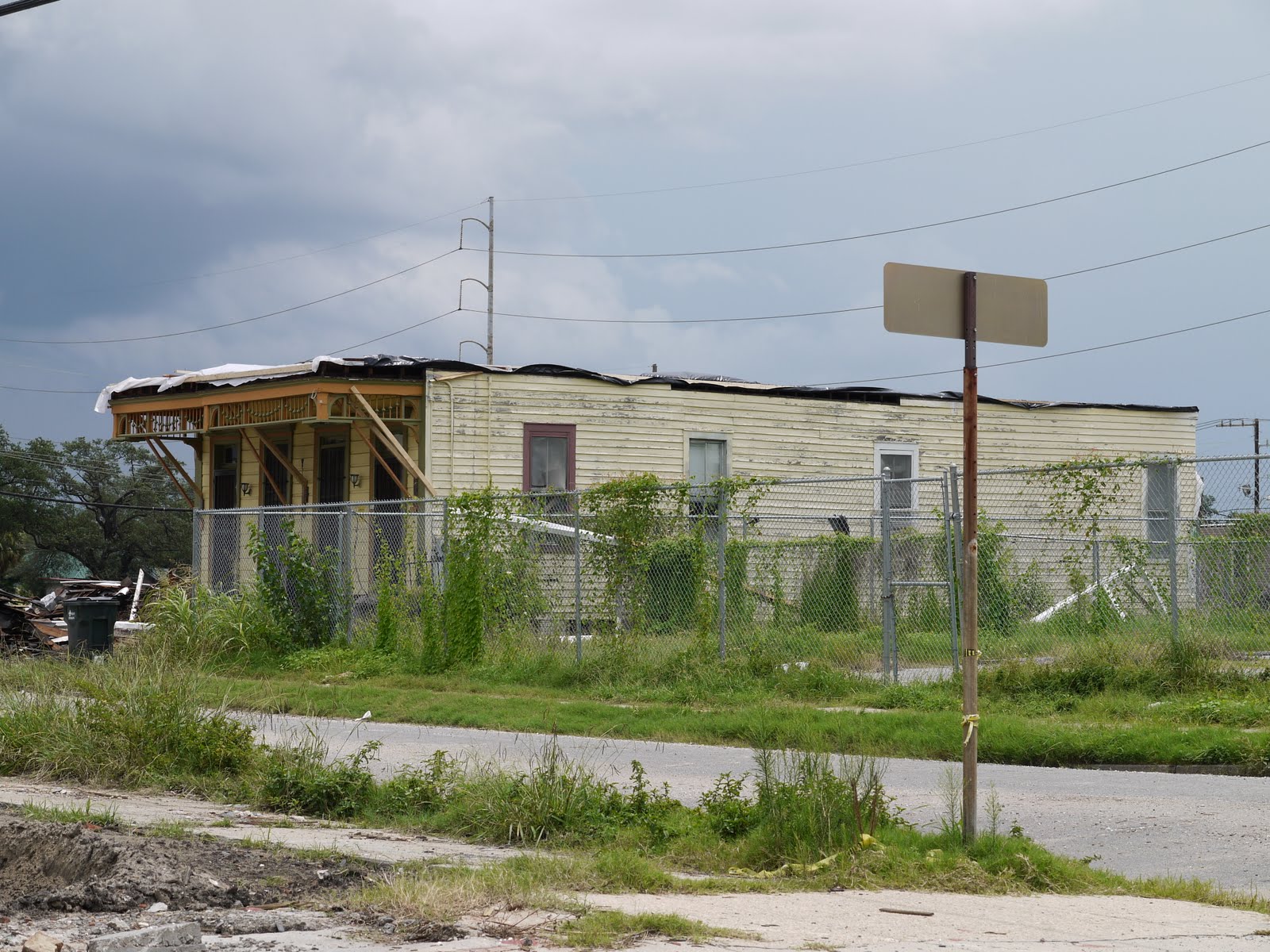
Sans Roofs in the LSU Footprint
Several of the homes being prepared for relocation out of the LSU Footprint stood without their roofs today.
More on Orleans House
As I noted recently, what appears to be renovation work began on Orleans House, an 1880s mansion at 1800 Canal Street. The parcel is inside the UMC or LSU Footprint, but the Office of Facilities and Planning Control has shown the building "still standing" after construction of the UMC in its various presentations at City Hall here in New Orleans in the past year or so. Still, as with many aspects of this project, uncertainty about the ultimate fate of the building remains because the Programmatic Agreement for the LSU/VA project speaks to a number of possible different outcomes for the historic building.
Fortunately, at present, all outward signs point to the building remaining intact and benefiting from repair work.
Additional research shows that the property at 1800 Canal was transferred this spring on the Ides of March, March 15, 2011. This came several months after the heels of Omni Bank's attempt to have the building sold at sheriff sale back in November of 2010. The building was ultimately pulled from the list before auction and the building then went up for sale in December 2010.
Orleans Parish Assessor's records indicate that RKG Enterprises, LLC and SLH Holdings, LLC are now the owners - after paying $330,000 in March, more than $100,000 below the total assessed value for the 2011:
A look at the Secretary of State's website shows the following listing for RKG Enterprises, LLC:
Per one source:
"Roy Madere Jr., a former Hubbard business partner, and Mike Knox, a man formerly employed by Hubbard Enterprises, founded RAMJ Construction."
Secretary of State records reflect that Madere is also the listed agent and member for RAMJ Construction, LLC, which was founded in October 2009:
RAMJ Construction has been involved in the site preparation in both the VA and LSU Footprints. Here, someone notes the many RAMJ connections to Hubbard Enterprises.
SLH Holdings, LLC does not appear in the Louisiana Secretary of State registry. There are a number of similarly named Louisiana corporations, but no exact match. There is an entity by the same name registered in Florida.
Labels:
corporations,
Orleans House,
RKG Enterprises,
sheriff sale,
SLH Holdings
Saturday, August 6, 2011
The roofs come off
As I drove by on the I-10 today, I saw crews removing the roof of at least one UMC house...
Echoes in the Past: June 5, 1935 - Big Buildings Can Be Moved
I can't tell you how many people have told me they don't believe that McDonogh No. 11 School can be moved. I tell them that it most certainly can.
And looking back, as a good, anonymous friend of the blog did, reveals a perfect example in timeline of the Charity Hospital complex itself. Here's the story from June 5 of 1935, before Big Charity itself was even constructed:
Friday, August 5, 2011
"the unique academic experience that students have come to expect"
Is that the unique experience of moving campuses multiple times in four years...only to get kicked out of your school at Christmas for a project without financing or a business plan...and then get moved to modular units far away?
The long, sad saga of Priestley Charter School continues beyond it's time at McDonogh No. 11 School in the LSU Footprint:
The Orleans Parish School Board (OPSB) announced on July 21, 2011, that Priestley Charter School of Architecture and Construction will be re-named Architecture Design Engineering Preparatory High School (ADEP High).
In late 2010, the Priestley Board of Directors voted to relinquish its charter to OPSB, citing ongoing concerns over finances and enrollment. ADEP High, located at 4300 Almonaster Ave., is now being run as a traditional school under the OPSB, with open enrollment for the 2011-2012 school year.
Gift-Wrapping
I hope there's been a chance for documentation of Olreans House fully before its renovation - which seems to be underway.
I'm still not clear as to who owns the building at this point. But here's the relevant Programmatic Agreement provision if the state's Facilities Planning and Control office is doing the work:
Labels:
documentation,
historic preservation,
Orleans House
Demo Diva Dumpsters and Tough Skanska Trucks
For the past week or so, crews have been working inside the former HIV Outpatient Clinic building in the UMC Footprint. Note the license plate and other details.
Thursday, August 4, 2011
UMC Board crawfishes yet again - delays Sept. meeting
Seriously. This comes after cancelling the August meeting set for today.
Things are getting curioser and curioser:
6,300 flyers
*Submitted photo.
The mysterious BioDistrict walker, going door-to-door, delivered 6,300 flyers to houses and businesses in the 1,500-acre BioDistrict New Orleans in the past week or two. Pretty incredible.
The mainstream media's continued refusal to cover the months-old controversy surrounding the BioDistrict is similarly incredible.
Wednesday, August 3, 2011
Work suddenly begins on Orleans House
Brackets and other items were being removed today from the Orleans House mansion at 1800 Canal in the LSU Footprint. I was quite concerned as I drove by and noticed it. Two "No Trespassing" signs popped up as well.
Two workers wrapping up for the day informed me that the building is not being taken down, but is instead being renovated. Let's hope.
Finalized Details on Mid-City Mitigation Grant Program
Here, via the Louisiana Division of Historic Preservation.
The full roll-out of the program is set for the August 8, 2011 Mid-City Neighborhood Organization meeting:
August 8, 2011
6:30 PM
Grace Episcopal Church
3700 Canal Street
The program is designed to award rehabilitation grants to owners of historic properties in the Mid-City National Register Historic District.
As I noted in my earlier post providing the first public details of the grant, the program was set up as part of the Programmatic Agreement that governs the LSU/VA project.
Rooftop removal reprised
Fox8 and The Lens took a look at the houses moved from the VA Footprint last evening (here and here).
The good news? A majority of the homes have had their roofs restored and the bulk of them are secured. Some of the moved houses, like Wally Thurman's former home, which is now located in Central City, are almost entirely complete.
The bad news? Approximately 28 of the properties, including 21 in Hoffman Triangle, have not had their roofs restored. And many of those, like the former home of Kevin Krause and Bobbi Rogers, are in generally poor condition.
As someone who advocated strongly for moving houses as an alternative to mass demolition in the VA Footprint, it's truly a shame to see the deplorable state of some of the houses. I did not push for moving houses after tearing their roofs off. Nor did I push for moving houses and then leaving them sit in a blighted state for months on end. Despite providing all kinds of input and suggestions on how to do things right, I've seen that the follow-thru on the part of the contracting parties involved just isn't cutting it.
The worst news, however? According to the piece in The Lens, the dozen or so houses set to be moved off the LSU Footprint WILL have their roofs removed. That's a really bad idea, something I've warned numerous involved parties against. It's going to lead to additional problems. It's also troubling to hear that neither the city nor BOH will release the destination lots; if they are still trying to secure lots, they should say just that - and they should ask for help.
I want the house moving effort to succeed, and I have done what I could to try to suggest better ways to go about moving in the LSU Footprint based on the lessons of the VA moves. But the continued delay in resolving issues surrounding the VA houses continues to threaten the legitimacy of the entire effort.
Labels:
Builders of Hope,
Fox8,
house moving,
LSU,
The Lens,
UMC
As signs come down
The Schadler Building at 1909 Tulane Avenue, in the LSU Footprint, housed Southern Electronics Supply until recently. The sleek modernist lettering was removed from a spot near the front door. Why Schadler?
Southern Electronics Supply was founded in 1932 as Southern Radio Supply by Alfons Schadler, a German immigrant with a degree in Electrical Engineering. He was forced into making this move because of losing his job during the Great Depression. The company has grown over the years into one of the most successful regional distributors in North America!
Labels:
displacement,
history,
Schadler Building,
Southern Electronics,
UMC
New Orleans tax rolls lose $45 million worth of property due to LSU/VA project
From a chilling caption in today's Times-Picayune:
About $45 million worth of real estate fell off the tax roll this year because of the clearing of more than 70 acres in Mid-City to make way for a new state teaching hospital and a new federal hospital for veterans.
Think not only of that figure. Think of how much room that overall value figure had to grow based on the fact that many of the properties in the Footprint were still revitalizing and coming back online after the storm when they were stopped cold by a 2007 city-imposed building and repair moratorium.
More importantly, think of that figure multiplied by five years of non-collection. By 10 years. By 50 years. The lost revenue to a city that is repeatedly facing budgetary problems and a shrunken population has been exacerbated by the LSU/VA project, and it's a problem that will compound over time. And this staggering loss will happen despite the fact that the state owns Charity Hospital as we speak, which could have prevented the destruction of a great many of the Lower Mid-City taxable parcels involved.
The Assessor's comments about some compensation from the increased value of properties nearby along Tulane Avenue offer little consolation. Their ultimate values depend on the project being completed - and the UMC hospital does not have the resources necessary at this time - years after it should have had its ducks in a row. The values along Tulane Avenue come with built in speculative risks. And they're built on the backs of people who wrongly had their properties expropriated for projects that took more land than they needed - because sprawling, mid-rise suburban-style designs were insisted upon.
There's also the fact that some of the property owners who had their properties seized still have not been compensated. I just received an email last night from one former VA property owner who told me "And no I never got paid for my house on Palmyra.... Yet."
Yet another glaring example of how bull-headed, destructive, and short-sighted this project has been from the start...rears its head.
Labels:
assessments,
LSU/VA Hospital,
property,
taxes,
taxpayers,
Times-Picayune
Incredibly ill-advised
You heard it here first, but Fox8 News traces the hectic and premature departure of the Blood Center, long located in the proposed LSU Footprint, to a temporary facility in an old car dealership in The East:
"It's just hard to sit here and watch it. We put so much into that facility. This is my life," said Blood Center President Billy Wheales. It's really mind boggling for me considering we have been here for more than 50 years."
The state gave the Blood Center an August 1st deadline to be out of the remainder of the building.
This has made for a hectic few weeks and an unusual move to New Orleans East to the site of an old car dealership. For a facility that supplies the entire region with blood, it's been a challenging transition," he says.
And there you have it. Functionally, by forcing the Blood Center out of the site unnecessarily, the State of Louisiana, LSU, and the UMC Board have jeopardized the blood supply, an important aspect of the metro region's healthcare.
The site plan for the UMC could have easily incoporated the Blood Center facility, but as with McDonogh No. 11 and Deutsches Haus, it decidedly quite forcefully not to do so. There was no reason to weaken or put the blood supply at risk when the land the facility sat on was not essential to building the proposed medical complex - a hospital that does not have adequate financing or a business plan.
As with so many aspects of this process, I'm forced to sit back and ask rhetorically, once again...where are the adults in the room? Can someone tell me what is really driving all this belligerent insistence? One can look at land, at power, at financial greed...but this just does not make any sense.
Labels:
bad ideas,
Blood Center,
blood supply,
displacement,
The East,
UMC
Tuesday, August 2, 2011
Robert Lashes Out
A strong proponent of re-using Charity Hospital - and opposing the excess of BioDistrict New Orleans - had this, among many other things, to say as he resigned from a neighborhood group in protest:
"Where are the City Council and the Mayors in all this? The question must be asked. I prefer to think they have been misled by glamorous promises of a new medical center and fail to understand that all those promises can be fulfilled by rehabilitating the Historic Medical Center. It is time for them to defend the City against a rabidly aggressive LSU and the State an d tremember we can have both contemporary development and historic preservation at the same time."
Rooftop...removal?
Last week, crews took the many chimneys down on this house on S. Johnson Street.
Importantly, the roofs of the dozen or so houses are still on. By this point in the VA Footprint house moving process, the roofs would all have been removed.
But I've been hearing rumblings that the roofs are indeed still set to come off. That would be highly unwise.
If the houses are moved with their roofs off, it will show that the city and Builders of Hope failed to learn the lesson from the VA Footprint experience. Removing roofs, as I've noted repeatedly, is the root cause of the problems with the moved VA houses nearly a year after they moved.
The roofs should not be removed from the houses set to be moved off the UMC Footprint.
Even Still
McDonogh No. 11 School stands in the LSU Footprint.
Note the shadow, however, of the high voltage power line pole visible on the building's facade.
That's still an issue.
Monday, August 1, 2011
Howl
...for it is laid waste, so that there is no house, no entering in...
The UMC and VA Hospital footprints in New Orleans on August 1, 2011, looking lakeward from the CBD. Note the number of structures that remain in the UMC site in the midground. Note, too, the stark vacancy of the VA site compared to the dense neighborhood around it - the same urban fabric that existed there one year ago.
Labels:
allusions,
CBD,
destruction,
LSU/VA Hospital,
New Orleans,
photos,
views
Subscribe to:
Posts (Atom)