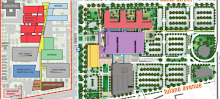
Right - and it's good to see the local television media questioning Governor Bobby Jindal about just how he plans to pull off the project given all of those concerns.
And there were concerns even before Mayor Mitch Landrieu questioned the UMC design for the LSU Footprint. Many of them remain. And they extend far beyond the design alone. They extend beyond the conveyance computer crisis.
For one, the size of the site itself is still excessive. The design changes may alter the chess pieces that sit on various spaces on the board, but the board size itself remains in place. The UMC Footprint boundaries have not been altered. Rehabilitating the existing Charity Hospital building is not back on the table - or, really, finally on the table for the first time since Katrina - from what I know.
Additionally, the question of funding remains. The UMC Board likes to talk as if the funding will fall in place - but it will take months to determine whether HUD will be able to back the remaining financing necessary to actually build the proposed hospital.
Beyond that, the continued demolition of historic structures that contribute to a national historic district continues. There is no concrete house moving plan for the UMC Footprint, unlike on the VA side of the project.
There are also people who continue to reside in the UMC Footprint - a fact that seems lost on Governor Jindal and others. There are also numerous working businesses in the site, some of them multi-million dollar enterprises - a security company, a guest house on the streetcar line, a uniform shop, an electronics firm, an independent auto parts store, and auto mechanic shops. The massive Blood Center will also have to relocate, as well as a charter school, Priestley, where students will be dislocated and moved to modular units halfway through the school year (over the holidays).
In fact, I wonder how many conservatives and Republicans across the nation know that Governor Bobby Jindal is backing an urban renewal-style government project that entails widespread use of eminent domain (expropriation here in Louisiana). I wonder if property rights advocates know that Jindal is backing a project that is now contemplating retail - private enterprise - as a direct beneficiary of the land acquisition in the UMC Footprint.
I bet they'd find that interesting. I know I do.
Wednesday, December 8, 2010


Tuesday, December 7, 2010
Houses of Steel - Unmoved

In the Lower Mid-City neighborhood outside of the Footprint, a place where moved houses are under rehabilitation along Bienville and other streets, a series of steel-frame houses are also under construction (and have been in some areas closer to Jeff Davis for months).
As someone pointed out to me, it's interesting to see these homes under construction as part of a large, concentrated infill effort - when there are still numerous homes available to be moved off the LSU Footprint...that could do the trick in the historic neighborhood just as well.

A Few More Gone on Palmyra

This photo is from a few days ago. Now, the gray house on the end, a former camelback, has been moved. So has the little white shotgun second from the right.
The house second from the left (with white pediment) remains and the green house does too - still occupied.
Newsweek Magazine Writes Piece on LSU/VA Hospitals

Author Jeff Benedict wrote this piece in the December 6, 2010 edition of the publication.
Monday, December 6, 2010
Christian Science Monitor Writes Story On LSU/VA Hospital Project
While the piece, which appeared online today, focuses on the house moving - one of only two moves where the owner went "with the house," the piece does get to some of the stark realities:
"Soon, this area will be flat as a prairie. Everything that once was Lower Mid-City is being dismantled, including the streets, lampposts, curbs, electric lines, and sidewalks."
I should note that this piece is not just a reprint of the AP story that I noted earlier today - it's a separate article that the Christian Science Monitor wrote, which just happened to come out on the same day (although interestingly...people working on the story for the publication were in the VA Footprint weeks ago).
"Soon, this area will be flat as a prairie. Everything that once was Lower Mid-City is being dismantled, including the streets, lampposts, curbs, electric lines, and sidewalks."
I should note that this piece is not just a reprint of the AP story that I noted earlier today - it's a separate article that the Christian Science Monitor wrote, which just happened to come out on the same day (although interestingly...people working on the story for the publication were in the VA Footprint weeks ago).
AP Story on VA Hospital Footprint Appears on sites of Washington Post, Fox News
A mainstream media reporter from the AP shows that he gets it - he sees the story of the VA Hospital Footprint for what it is - an attempt at urban renewal that has consequences for people who were simply trying to get back on track following a major disaster.
The headline alone shows a deeper understanding of the sad irony involved in the project than many of the pieces from media outlets thus far: "Neighborhood survives Katrina - not urban renewal"
The headline alone shows a deeper understanding of the sad irony involved in the project than many of the pieces from media outlets thus far: "Neighborhood survives Katrina - not urban renewal"
Weaving Back In

Yesterday, I caught the Dumaine Street Gang as it second lined through the Treme. One friend snapped this great shot as the throng of people passed a moved VA Footprint house on St. Philip Street (in yellow) that once stood on Banks Street.
At various points along the route, I stood and marveled at just how important the historic architectural streetscape was to the second line phenomenon. Take away the distinctive houses and buildings that make the cultural tradition undeniably New Orleans, and it would be a wholly different thing. In that vein, it's encouraging to see the houses saved from demolition in the VA Footprint weaving themselves slowly back into the street fabric.
Last week, inside the Footprint, someone stole my laptop and back-up camera from my car while I was in at Outer Banks bar to check in on the Committee to Reopen Charity meeting (I didn't think I had left my laptop bag in my car, but alas). I lost many, many photos. But when I saw the wild, joyous life of the second line pass the moved house on St. Philip yesterday, things equalled out a bit. It was easier to accept the loss. All of the effort, all of the difficulty over the past nine months or so paid off when I saw a bit of the tangible outcome of the push to extract positives from the unwise hospital sites.
Everyone involved in the house moving undertaking - whether it was Builders of Hope or Mary Howell, who really sparked it all back in March - managed to help give New Orleans new life without forsaking what's best about the city, what makes it unique and worth celebrating.
Sunday, December 5, 2010
"Dramatic Changes"
Fox8's Shelley Brown catches up with the drastic transformation of the VA Hospital Footprint in recent weeks in a recent report.
The tv news spot also announces a jazz funeral for the neighborhood.
The tv news spot also announces a jazz funeral for the neighborhood.
The Charity Hospital Option - Looking Better all the Time
Today's Times-Picayune piece - solidly factual in its assessment - cannot help but highlight the folly of the decision to build the University Medical Center in Lower Mid-City.
This paragraph, while objective in form, says it all:
Further delays could threaten to push UMC's opening date into 2015. Aug. 29 of that year would mark a full decade after Hurricane Katrina led to the flooding that incapacitated Charity Hospital. State officials mothballed the downtown hospital by the end of September 2005.
This important set of facts crops up as well:
The lost and damaged records in Clerk of Court Dale Atkins' office, which make it impossible to complete title searches, has delayed the purchase or expropriation of at least 124 of the 244 parcels on the Mid-City footprint that is slated to become University Medical Center. As of last week, the state owned or controlled 108 individual properties.
This scenario puts the demolitions in the UMC Footprint in some context: they increasingly look like an attempt to convey the impression that the project is well underway and irreversible...when in fact, there are a whole host of uncertainties and obstacles that remain in place.
This paragraph, while objective in form, says it all:
Further delays could threaten to push UMC's opening date into 2015. Aug. 29 of that year would mark a full decade after Hurricane Katrina led to the flooding that incapacitated Charity Hospital. State officials mothballed the downtown hospital by the end of September 2005.
This important set of facts crops up as well:
The lost and damaged records in Clerk of Court Dale Atkins' office, which make it impossible to complete title searches, has delayed the purchase or expropriation of at least 124 of the 244 parcels on the Mid-City footprint that is slated to become University Medical Center. As of last week, the state owned or controlled 108 individual properties.
This scenario puts the demolitions in the UMC Footprint in some context: they increasingly look like an attempt to convey the impression that the project is well underway and irreversible...when in fact, there are a whole host of uncertainties and obstacles that remain in place.
Friday, December 3, 2010
Thursday, December 2, 2010
On the LSU Side of Things

Some interesting brackets were being taken down today at a double shotgun house on Palmyra Street in the LSU (UMC) Footprint.
Yesterday, crews demolished a shotgun house on Cleveland Avenue after salvaging:

Last Evening

The remains of the raised basement house at 2315 Banks Street sat quietly as the sun went down over the VA Footprint.
Crews, along with a pickup team from Habitat for Humanity, did salvage a number of architectural details from the building prior to demolition earlier in the day:

Wednesday, December 1, 2010
Sheila Jackson's House

The little shotgun house from 2430 Cleveland rolled down Palmyra today amidst the devastation.

Tuesday, November 30, 2010
Event at Outer Banks Bar Tomorrow (Dec. 1)

The Committee to Reopen Charity Hospital is holding an event at Outer Banks Bar tomorrow. Here are some additional details from Mr. Brad Ott, a member of the group:
The Committee to Reopen Charity Hospital will hold its regular Wednesday meeting, 6:30pm to 8pm at a new location -- The Outer Banks Bar, Palmyra and South Tonti Streets. As road access is extremely limited due to the destruction of the neighborhood, attenders are advised to enter via Palmyra from the South Dorgenois intersection. Our agenda includes updates from remaining area residents and business proprietors still facing expropriation/demolition, reports and information on the status of the S.W. Green Mansion, Dixie Brewery, the impact of the Orleans Parish Real Estate records' computer crash, the just-released Advisory Group on Forced Evictions Mission Report to New Orleans, United States (an advisory group to The United Nations-Habitat) and other items as brought forth to be considered by attending participants. Dress warmly, as the first part of the meeting could be held outside. For more information, contact Brad Ott at (504) 269-4951 or bradott@bellsouth.net.
Mr. Derrick Morrison of the Comittee provided the flyer seen at the top of the post.
Coming Into View: The House Moving Effort
Here's the latest version of the Google map showing the VA Footprint house exodus to new lots throughout New Orleans. I now have the data entered for the first fourteen "move days" - through mid-November.
Be sure to zoom out so you don't miss any:
View LSU/VA Hospitals Footprint - Lower Mid-City, New Orleans in a larger map
Wally Thurman's home, formerly at 217 S. Tonti, made it all the way to a new spot at Second and Danneel in Central City on the edge of the Garden District where it awaits rehabilitation in front of a large sycamore tree:

Be sure to zoom out so you don't miss any:
View LSU/VA Hospitals Footprint - Lower Mid-City, New Orleans in a larger map
Wally Thurman's home, formerly at 217 S. Tonti, made it all the way to a new spot at Second and Danneel in Central City on the edge of the Garden District where it awaits rehabilitation in front of a large sycamore tree:

Weasel Words
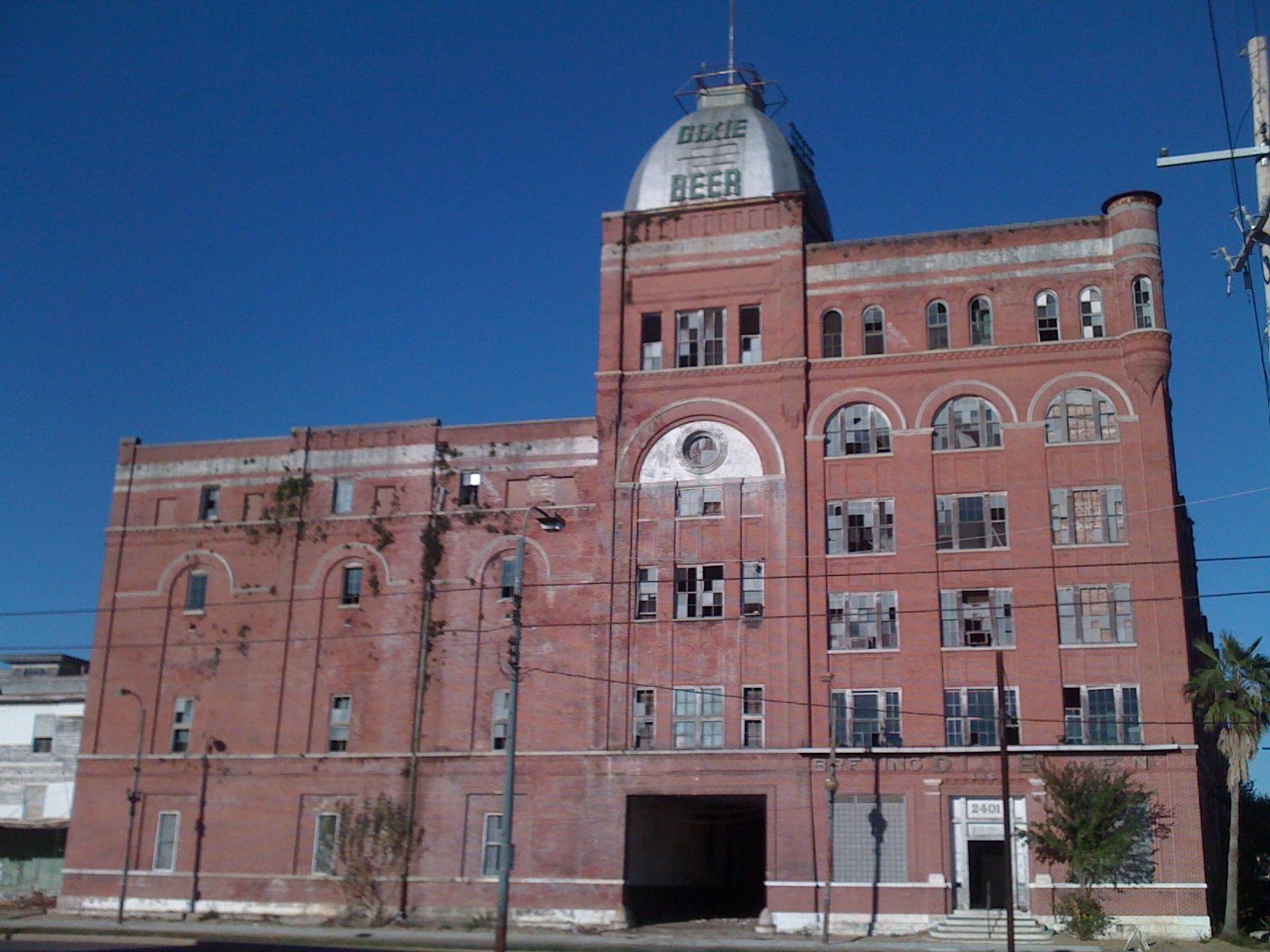
As I've long told anyone who asks, there's no guarantee that even a substantial part of Dixie Brewery will be preserved.
Here's the operative language from the Programmatic Agreement for the VA Medical Center site preparation:
That leaves a good deal of latitude with respect to what's "feasible" and "significant" - if you ask me.
Here's the operative language from the Programmatic Agreement for the VA Medical Center site preparation:
ii. If feasible, VA will retain and rehabilitate the Dixie Brewery
addressed at 2401 Tulane Avenue and integrate this historic
building into the design of the new VAMC. VA, in consultation with
the SHPO, will first assess the structural stability of the Dixie
Brewery and determine if it will be feasible to retain the structure in
its entirety. If it is concluded that it is not possible to retain and
rehabilitate the entire structure VA will identify the significant
features of the Dixie Brewery and integrate those features of the
historic building in the design of the new VAMC. That leaves a good deal of latitude with respect to what's "feasible" and "significant" - if you ask me.
De-Facaded

Crews work with Habitat for Humanity representatives to place salvaged items from a shotgun on Cleveland Avenue in the LSU Footprint.
As always in the LSU Footprint, it's good to see salvage underway...but it needs to be placed in context. Salvage shouldn't even need to happen. Many of the homes should be moving off-site, just like the many homes moved off the VA Footprint.
Parking Lot of the Grand Palace Hotel

As demolition companies sought a contract to demolish the old Grand Palace Hotel at 1732 Canal Street (down at today's Summit on Economic Opportunities for Local Businesses), a knot of people gathered outside the parking lot that adjoins the vacant, towering building in the lower part of the LSU Footprint.


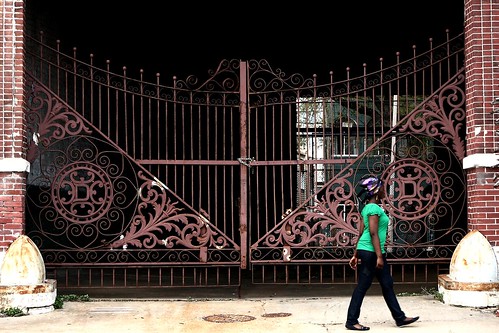
The Dixie Gates - Gone

The elaborate gate on Tulane Avenue has disappeared.

Here's a photo from Michelle Kimball at the Preservation Resource Center, which gives an impression of the distinctive metalwork that made up the gates.

It's not clear what happened to the gates. There's a chance the owners may have removed them preemptively, as the state was threatening to expropriate the brewery yesterday.
ADDED:
Here's photographic proof from a reliable source that the gates were already gone as of this past Saturday, November 27, 2010:
"Computer crash holds up LSU/VA Hospital"
From WDSU.
There's not much meat in the story, but it does point out a relevant fact, something I've mused about here before.
There's not much meat in the story, but it does point out a relevant fact, something I've mused about here before.
More Houses in Hoffman Triangle

228-30 S. Miro Street is now on First Street, along with the other houses pictured here, all of which await full rehabilitation after arriving recently.

Here's Bobby and Kevin's camelback in its new locale.

This orange house once stood immediately nextdoor to Outer Banks Bar on Palmyra.
The Peripheral People

Here's a shot from yesterday looking toward the Lake on Cleveland Avenue. It's a view of the street after it leaves the VA Hospital Footprint, however, and proceeds for two blocks to Broad Street.
As I discovered Saturday night, due to a total lack of signage or other notice, the street is not passable - it is torn up beyond even New Orleans low standards of what makes for a drivable street. I barely escaped without damage to my car, and I had to cut through a parking lot to get off the street in the end because excavators were blocking the end of the street where it exits onto Broad. It's a complete mess, it's functionally a non-street, and many people live along the street.
Even for those who don't live Inside the Footprint, the project has negative impacts. There was barely any planning to show consideration for the people in the site, and there has apparently been absolutely none for those who live in its immediate vicinity. A number of the peripheral residents attended the most recent VA meeting to complain about the disruptions.
Subscribe to:
Posts (Atom)