Friday, September 10, 2010
Thursday, September 9, 2010
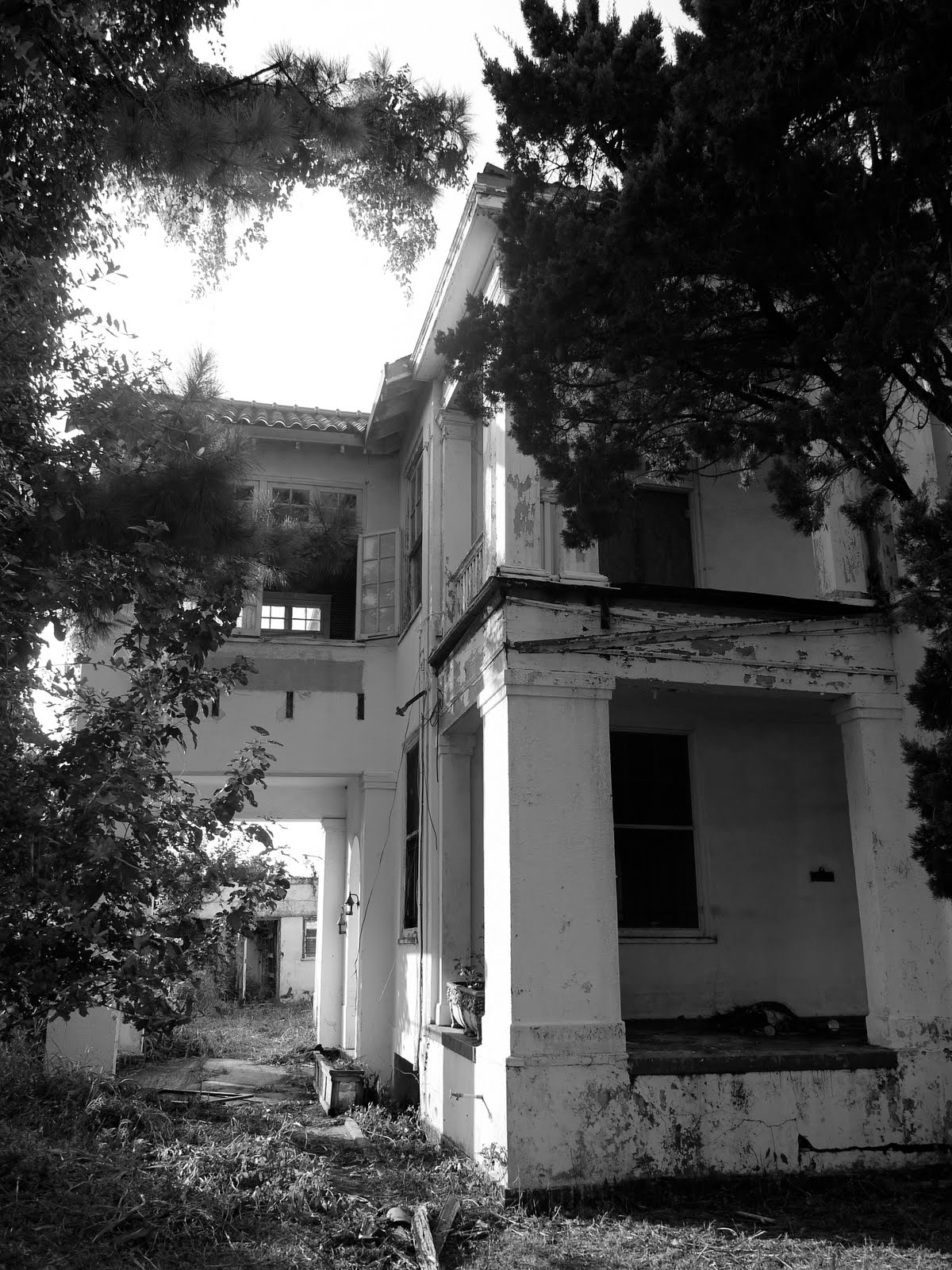
2426 Palmyra
This house is set to move tomorrow.
You may recall this image of the house from earlier - fitting on a day like today!
Someone at Outer Banks Bar was also thinking of the Who Dat? season in the last day or two, it seems:
218-220 S. Tonti
Yesterday.
Today.
The house, directly across the street from the home of noted former resident Wally Thurman, is slated to be moved. Along with it's neighbor immediately downriver, it sports some of the most elaborate and unique brackets in the VA Footprint.
Lower Mid-City...Elsewhere
What was once a camelback on S. Galvez...is now a house in the 2500 block of Orleans Avenue.
Crews from Tim Clark Construction and Orleans Shoring labored to get the house into its new location late yesterday.
The other two houses, shotguns, were parked near their future sites on N. Rocheblave Street between the exotic old General Laundry Cleaners and Dyers building and the new homes rising on the site of the former Lafitte Projects.
Labels:
camelback,
General Laundry,
house moving,
Orleans Avenue
House Moving Press Conference - Tomorrow, Inside the VA Footprint
MEDIA ADVISORY
FOR IMMEDIATE RELEASE
September 8, 2010
Contact:
Ryan Berni
504-658-4992 (office)
504-417-1933 (cell)
MAYOR LANDRIEU TO MARK THE MOVING OF HISTORIC HOMES IN VA FOOTPRINT
New Orleans, LA— On Friday, Mayor Mitch Landrieu and city officials will mark the moving of approximately 100 historic homes currently in the VA hospital footprint in Mid City. The homes were initially slated for demolition, but Mayor Landrieu reprogrammed $3.2 million in CDBG funds to have the homes moved in conjunction with Builders of Hope and local non-profit organizations.
WHO: Mayor Mitch Landrieu
New Orleans City Council
Builders of Hope
Neighborhood and non-profit leaders
WHAT: Press conference on the moving of historic homes in the VA footprint
WHEN: Friday, September 10, 2010
10:30 AM CST
WHERE: 2426 Palmyra Street
New Orleans, LA 70119
*I've been told that the press conference will take place at the intersection of S. Tonti and Palmyra...with 2426 Palmyra "rolling past" at some point (it's one of the houses set to move tomorrow).
Labels:
house moving,
Mayor Landrieu,
press conference,
VA hospital
Wednesday, September 8, 2010
Historic Houses on Parade
More photos coming soon.
The three houses ran into a few snags along the way - like a car on S. Galvez near Bienville...that had to be "excavated" out of the way at around 1 p.m.
People stopped and stared all the way along the route. It truly was fascinating to see the houses in strange contexts as they moved down the streets.
It was bittersweet to see the neighborhood leaving. Bill Borah, the veteran of another fight decades ago, walked away as the second house crept around the corner past Deutsches Haus.
Builders of Hope, a national non-profit, is overseeing the moves. Local contractor teams from Orleans Shoring, Durr, and Jacobs are also heavily involved in the process, as are teams from Cox, Entergy, and RTA, as well as the NOPD.
Tuesday, September 7, 2010
Today's Update - First Batch of House Moves Imminent
These three houses on S. Galvez will be the first three to be moved tomorrow, Wednesday, starting at 10 a.m. Three additional homes will be moved out on Friday, according to the current schedule.
Crews began deconstructing this 4-bay shotgun house on S. Miro today - and stated that it was slated to be demolished, not moved. It is a contributing property in the Mid-City National Register Historic District.
Crews continued to prepare this house on Banks for moving, removing the roof.
By the time afternoon rolled around, the third of the three houses to be moved tomorrow was up on wheels.
Monday, September 6, 2010
The Corner Store
Recently, I noticed that the light was on (and it had never previously appeared to be inhabited). Then, last week, I saw a work team inspecting and going inside. Later, the doors and windows were boarded up.
The building, a joint residence and commercial space initially, is one of several former small-scale commercial structures in the VA Footprint. The beveled entryway with post on the corner is a telltale sign.
Sunday, September 5, 2010
Special Detail
An NOPD Officer watched over the partially deconstructed Frenchman Inn this Sunday morning, inside the footprint.
The March
On Thursday, hundreds marched on City Hall to deliver petitions asking Mayor Landrieu to renew, restore, and re-open the Rev. Avery C. Alexander Charity Hospital.
Labels:
Big Charity,
brass bands,
City Hall,
marches,
Mayor Landrieu,
Save Charity,
second line
Friday, September 3, 2010
Today
233 S. Galvez (green on jacks) and 229 S. Galvez (white with brackets on wheels) await the move out of the VA Hospital Footprint next week.
Crews also started removing the front and sides of the old Frenchman Inn at Palmyra and S. Miro.
The home at 2426 Palmyra was also shorn of its roof in preparation for moving, as was one house on S. Rochblave.
Labels:
Frenchman Inn,
house moving,
Palmyra Street,
S. Galvez Street
The First Set of House Moves
The first round of house moves from the VA Hospital site under the supervision of Builders of Hope is slated for Wednesday.
Note that the first address listed for each entry is the current address of the property and the second address is the future location elsewhere in the city.
I've linked the first address in each entry to a photo of the house and the second address in each to a map location of the new site:
218 S. Rocheblave to 1833 Bienville St.
229 S. Galvez (+ camelback, not pictured) to 2549 Orleans Ave.
233 S. Galvez to 627 N. Rocheblave
2405-07 Banks St to 220 N. Derbigny/ Bienville corner lot 13-A
2426 Palmyra to 2332 St. Louis
237 S. Galvez to 627 (A) N. Rocheblave
Thursday, September 2, 2010
The Pace Quickens
These three houses on S. Galvez Street are slated to be the first three moved off the VA Footprint site by Builders of Hope.
As you can see, the roofs and porches have been removed from the two houses on the right, and a crew is currently removing the roof of the pink double shotgun on the left. Streetcar and power lines apparently necessitated the transformations for moving. The camelback "hump" of the camelback will ostensibly be removed and transported separately. I'm concerned about what this might mean for the houses' National Register "contributing status" that determines eligibility for various things related to ownership and rehabilitation of an historic home.
I've heard varying numbers from varying sources as to how many houses will be moved, and I'm quite certain the list is still somewhat fluid.
Overall, there were more work crews out in the VA Footprint today than I've ever seen before - working at a variety of sites. One group informed me that they had caught a thief who was stealing architectural elements off houses in the Footprint, a problem in recent weeks as outlined here. The police presence in the Footprint has certainly gone up as of late, too.
This house on Palmyra was also seemingly being prepped for a move:
Wednesday, September 1, 2010
Guest Piece: A Crucial Piece of Black History Faces Wrecking Ball in Louisiana
Text by Kenneth Bryant, Architect
NEW ORLEANS
Eighty years before President Obama moved into the White House, S.W. Green, the son of a former slave, not only moved into a huge white mansion, he had his built to order. Constructed in 1928, Mr. Green’s 17-room home at 219 South Miro Street became the envy of New Orleans’ black community. Its construction caused quite an uproar. When halfway complete it was set afire, burned reportedly by the Ku Klux Klan. Arsonists considered it an affront that a black man would build a house bigger than theirs, near their neighborhood. This malicious act demonstrated the ravages of segregation, how unreasonable and devastating.
But Green did not give up; he finished the house undeterred. In a town known for Gilded Age residences, Green’s white house is the city’s best example of early 20th-century African-American residential architecture. It may be the only (remaining) Afro-American mansion in the “Crescent City” from this period. The irony is that eighty years later, despite electing a black president, an Indian Governor, and an Afro-American mayor, the city of New Orleans is gearing up to do what the Klan failed to accomplish, demolish S.W. Green’s symbol of American perseverance.
The house is threatened because the State wants to make way for a new VA Hospital-LSU Medical School. Yet according to a recent study by RMJM Hillier, renovating the old facility would save taxpayers $283 million, and would hold harmless many historic buildings. But LSU wants to bulldoze the neighborhood, and relocate onto this site where S.W. Green took a stand against oppression by building a house that represents hope. Urban renewal and destruction of black history have too long been synonymous. LSU is not merely tearing down the past; they are ripping up the future, one in which children can learn black history through visiting historic sites. S.W. Green faced barriers his contemporaries never endured. To amass the fortune that made possible the building of his dream house, Mr. Green overcame obstacles such as Black Codes, Jim Crowism, and racial covenants. Yet he persevered.
Green was a grocer, who later became president of Liberty Independence Insurance. In 1908 he was appointed head of the “Colored Knights of Pythias.” From 1908-1935 he built a “fraternal empire” worth $10,000,000, earning him the title, “richest ‘black’ man in New Orleans.” Green also erected the Pythian Temple, a 7-storey office building that still stands on Loyola Avenue. Dedicated 1909, at a cost of $200,000, it was arguably the costliest building ever constructed with African-American funds. Green’s success was a team effort that included his wife “Laurenia.”
She assisted him in running his business; and as a member of the NAACP, she was active in the early struggle for civil rights, perhaps, because the Greens had experienced injustice firsthand. In 1915, traveling back to New Orleans from a convention in Florida, Mr. Green was attacked by a mob for purchasing a private cabin onboard a Pullman train. Feared lynched and rumored dead, he was missing for several days; he was sent to prison, charged with violating Jim Crow laws. Lesson being, “the darkness of his skin trumped the depth of his pockets.”
As an African-American architect and historian, I am pleading with Governor Jindal not to demolish this crucial piece of black history—because it represents the hopes and dreams of a people who just 60 years before had been enslaved. I beg the governor not to evict the residents of Mid-City from their homes. I ask that part of the $2 billion allocated to build a new VA Hospital-LSU Medical School be used to bring the neighborhood back to life by saving its historic homes and restoring the S.W. Green Mansion, thus turning it into a house museum/visitors center so that black kids - growing up in a city of turn-of-the century mansions - will be able to see that someone who looks like them also built a grand, early 20th-century Louisiana home.
Sadly, despite surviving hurricanes and arson, the one storm that the S.W. Green Mansion may be unable to overcome is “ignorance,” the negligence of culture unwilling to appreciate its past. For now Green’s white house lives on, if only for a few more months. Its green-glazed Mediterranean-tile roof still glistens in the mid-day sun. The sweet sultry scent of jasmine that once filled its gardens, however, after Hurricane Katrina has been replaced by the smell of mildew familiar to all who have ever visited a vacant home. - KENNETH BRYANT
---
For additional information contact Kenneth G.H. Bryant: Ken Bryant is an architect, artist and author of color. He holds degrees in Art and Architecture from Tulane University, plus an advanced degree from Dartmouth where he wrote a dissertation on the architecture and historic preservation of African-American sites such as the S.W. Green House. Bryant operates a boutique design firm in Manhattan that focuses on high-end classical and contemporary residences. He discovered the S.W. Green House in spring of 1996 while skateboarding when he was a student at Tulane. “Finding a Neoclassical-Revival mansion in a ghetto was so unusual I thought surely it was built for an Afro-American,” Bryant says. He rang the doorbell—a maid answered. The homeowner confirmed it was built by blacks, in fact, by arguably the richest black man in New Orleans in the 1920s. Kenneth Bryant has made it his lifelong goal to save historic buildings (often by early black architects) in marginalized communities. — (212) 290-5300 or kbryant@kghbarch.com
Wrong Place, Right Time
This morning, sensing far more preparatory activity evident in the VA Footprint, I confirmed with the crew working on S. Galvez Street that two houses in the VA Footprint are being prepared for a move, as opposed to demolition - these two. It seems the camelback immediately to the right will not, apparently, be moved.
The roof on the green house was being torn away - I'm not certain how that factors into the moving process, but I hope it's part of the plan. One of the key goals of the moving process should be to retain the historic character of the structures so that they retain their contributing status to the Mid-City National Register Historic District (it's my understanding that they will be moved to other sites within that same District).
The situation in the Footprint is on the brink of a tipping point. At least some historic houses are ostensibly going to be moved. That's a better outcome than demolition of every home.
But it's still a reminder that the effort to stop the elimination of the residential area above S. Galvez is in its final hours. Even if some homes are saved and moved elsewhere, the terrible decision to build the VA Hospital in an historic district and a neighborhood, detached from the Central Business District is about to come home to roost. To flip Dr. John's famous line, it's the right time (to bring care back online) - but it's very much the wrong place. Especially if LSU is unable to complete its planned adjacent medical complex.
There's still at least one chance. That's the rally tomorrow to deliver petitions to Mayor Landrieu. With enough community outpouring, it's difficult to say what he might be willing to do. But there is still that chance. See the posts below for details.
One more thing. Recently, someone suggested that the effort to move the houses off the site will suddenly be a huge burden to taxpayers. I found the argument rather absurd. For one, demolition, too costs something. Second, a responsible multi-billion dollar project should have accounted for adequate moving costs and historical preservation from the outset. And finally, there wouldn't be any issue over moving costs at all if we had not seen such belligerent insistence on building in Lower Mid-City - a place where people are still living even as homes are demolished around them.
Labels:
demolition,
Dr. John,
Mayor Landrieu,
moving houses,
rally,
VA hospital
Tuesday, August 31, 2010
Salvage Work Proceeds on Banks Street
This raised basement house at 2415 Banks was shorn of its decorative elements this morning.
Two unfinished structures were also razed at the corner of Palmyra and S. Tonti.
Monday, August 30, 2010
Demolitions Restarted
On my return to the VA Footprint today, I saw that three additional properties have been demolished on S. Tonti Street, two of them contributing properties in the National Register Historic District.
In the photo above, the first and third houses from the left were demolished earlier. As of today, the second and fourth houses from the left (contributing properties) are now gone as well. An additional apartment structure visible only barely (black metal steps) has also been demolished.
ADDED: Here is what the row of houses looked like as of the evening of 8/30/10:
ADDED: Here are shots of the two contributing properties that were destroyed, as mentioned above: 317 S. Tonti and 321 S. Tonti.
Wednesday, August 11, 2010
Sunday, August 8, 2010
Monday, August 2, 2010
A Shift Inside the Footprint - and Outside as Well
I've been off studying for and taking the Bar, and it's good to be back.
In the roughly two weeks I've been gone, the overall picture of the prospects for the Footprint have changed.
While it's unfortunate that Louisiana and the nation are suffering through a period of economic uncertainty, that black cloud may have silver lining as it relates to the people and the historic architecture of the neighborhood.
In this week's edition of The Louisiana Weekly, Christopher Tidmore takes an in-depth look at the politics and players involved in the controversy and makes a rather significant finding. The headline of the lengthy feature article sums up the new atmosphere that surrounds the project:
"Delays, Cost Overruns May Save Neighborhood"
Here's the introduction to the piece:
The article goes on to outline the grim fiscal realities that may ultimately save the neighborhood - the parts that weren't already demolished.
It's unfortunate that dedicated medical care has not yet been restored to the community as anticipated. But the new fiscal climate makes even more apparent what many, myself included, have been arguing all along: a more limited footprint and the inclusion of the existing Charity facility in the plans is the faster, cheaper, and more responsible way forward.
Sandra Stokes of the Foundation for Historical Louisiana does a great job of outlining the details of those arguments in the body of the Tidmore article linked above. Be sure to read the whole thing.
In the roughly two weeks I've been gone, the overall picture of the prospects for the Footprint have changed.
While it's unfortunate that Louisiana and the nation are suffering through a period of economic uncertainty, that black cloud may have silver lining as it relates to the people and the historic architecture of the neighborhood.
In this week's edition of The Louisiana Weekly, Christopher Tidmore takes an in-depth look at the politics and players involved in the controversy and makes a rather significant finding. The headline of the lengthy feature article sums up the new atmosphere that surrounds the project:
"Delays, Cost Overruns May Save Neighborhood"
Here's the introduction to the piece:
What had seemed impossible only a month ago, suddenly entered the realm of reality over the last week. The news that the new LSU Medical Center would take at least another six months over its original estimated opening date, and cost millions more than was originally proposed for its construction left some senior state officials wondering if the demolition of a historic, 19th-century neighborhood in Mid-City was the best answer.
The article goes on to outline the grim fiscal realities that may ultimately save the neighborhood - the parts that weren't already demolished.
It's unfortunate that dedicated medical care has not yet been restored to the community as anticipated. But the new fiscal climate makes even more apparent what many, myself included, have been arguing all along: a more limited footprint and the inclusion of the existing Charity facility in the plans is the faster, cheaper, and more responsible way forward.
Sandra Stokes of the Foundation for Historical Louisiana does a great job of outlining the details of those arguments in the body of the Tidmore article linked above. Be sure to read the whole thing.
Subscribe to:
Posts (Atom)