Wednesday, January 19, 2011
Video of Outer Banks Bar Demolition
As I noted on the day the building was demolished, nobody was watering the site as the demolition went down.
Here's the link to the video to see it in full.


Three Major Meetings - and a Special Visit
It's been a busy 24 hours in the ferment that swirls around the LSU/VA hospitals project. VA Neighborhood Meeting. UMC Board Meeting. City Council Committee Meeting. I'll have more details later.
Tuesday, January 18, 2011

Monday, January 17, 2011
Displacement Caused by the LSU/VA Hospitals Project
The number of people who have been or who are about to be displaced by the project in Lower Mid-City is staggering.
From the Programmatic Environmental Assessment for Site Selection, published in November 2008:
A total of approximately 618 persons are estimated to reside currently on these two sites in a total of 265 housing units. These totals include approximately 331 residents and 140 housing units on the VAMC site and 287 residents and 125 housing units on the LSU AMC site (ESRI 2008). As a direct result of the proposed projects, these residents of the proposed VAMC and LSU AMC sites would be displaced and required to relocate to housing outside of the project areas.
The VAMC site, once home to 331 residents, is now home to a mere handful of people.
The PEA goes on to make this statement, a real gem:
Considering the relatively small number of persons that would be displaced, the population of the City would not be significantly affected, though there could be minor changes in the populations of Planning District 4 and other local planning districts if the displaced residents decided to remain in the City.
Relatively small? Relative to what? Forcing over 600 people out of their homes seems somewhere closer to "big" on the scale I'm using. There's also this from a subsequent environmental assessment for the VA Footprint:
The actual number of residents on the site is not available. This SEA incorporates the conclusion of the PEA that given the small number of residents on the VAMC Site-Specific Environmental Assessment site in comparison with the total population of the City of New Orleans, the potential impacts to population would be minor.
Minimizing the mass displacement of hundreds of people by making it a percentage is laughable. It muddies the issue intentionally.
Functioning businesses, too, were/are being displaced en masse. The VA Footprint alone sported 24 businesses as of 2008. Today, there are none.
Mickey Weiser of Weiser Security had this to say months ago:

His company moved out this month:

As Roberta Gratz noted in her recent book, The Battle for Gotham, the damage to individuals, businesses, and families involved in the "downward spiral" triggered by mass relocations is both deep and broad.
Meeting on Wednesday
New Orleans City Council
Housing and Human Needs Committee
2 p.m., Wednesday, January 19, 2011
Council Chambers
+ The meeting is being held as required under the ordinance that closed the streets in the VA Footprint and called for periodic updates on the relocations and buyouts necessitated by the project.
A number of residents and business owners from the VA Footprint and surrounding affected areas plan to attend to speak about their experiences.
Sunday, January 16, 2011
"I look out every day to see a house torn down"
FOX8 put out a great piece on Friday about the uncertainties facing the UMC hospital proposed for the dwindling neighborhood in the LSU Footprint.
The financing uncertainties are also addressed...to some extent. One might come away from reading the linked piece thinking that there's simply a delay because of a desire to get the best financing. In reality, the stakes are a bit higher - it's about whether the hospital gets the necessary financing at all.
The ground breaking was supposed to take place before 2011, but now the state doesn't even have a date, according to spokesperson Michael DiResto. And more than half the land needed still isn't in the state's possession.
The financing uncertainties are also addressed...to some extent. One might come away from reading the linked piece thinking that there's simply a delay because of a desire to get the best financing. In reality, the stakes are a bit higher - it's about whether the hospital gets the necessary financing at all.
Curbs of Granite

A pile of granite curbing - likely installed along the 2500 block of Cleveland Avenue in the late 19th Century - sits in a pile on the dirt road version of S. Rocheblave recently.
Granite curbing lasts decades longer than typical concrete curbing, and it's a detail nuance in the New Orleans landscape that helps to set the city apart. Here's an example from the neutral ground on S. Galvez Street between the VA Footprint and the LSU Footprint:

Saturday, January 15, 2011
Yet Another House Demolished in LSU Footprint

Drop by drop, I will persist in pointing out the fact that demolitions continue in the LSU Footprint, site of the planned University Medical Center (UMC), which does not yet have financing lined up to build the proposed structure. The frog is being boiled slowly so that nobody will notice all at once. House by house, LSU is getting the LSU Footprint demolished. At some date, the site will hit a point where the clearing of the entire Footprint looks like a fait accompli because there will be so little historic fabric left. All this despite a project funding hurdle of several hundred million dollars that remain to be secured.
The house that once existed at right at 2118 Cleveland Avenue was a contributing structure in the Mid-City National Register District and eligible for the National Register of Historic Places. Salvage of the property started back on October 6, 2010, but the building was not demolished until now, apparently until after the occupants at left, Mr. Joe and his wife, had departed.
Here's what it looked like as salvage got underway:

Blast from the Past #2

A view of the VA Hospital site from S. Rocheblave, January 15, 2011.
Here's a site analysis from a May, 2006 VA Report - where the current proposed LSU Footprint alone, at 37 acres, was noted as adequate for both the VA and LSU hospitals:

As you can see above, something changed.
Death Roll

Alex Glustrom provided this extraordinary still from his video of Outer Banks Bar as it fell a few days ago.
[Click to enlarge]
Very Interesting - A New Step in the Charity Adaptive Reuse Process
Did you see this?
Did you know about the January 12, 2011 meeting? Did you attend?
Additionally, if you are a consulting party in the Section 106 process regarding the disposition of Charity Hospital, did you get notice of this particular meeting, an endeavor to promote adaptive reuse?
Here's the programmatic agreement (PA) speaking to the notice requirements for the adaptive reuse process for Charity Hospital:
Did you know about the January 12, 2011 meeting? Did you attend?
CHARITY HOSPITAL ADAPTIVE REUSE
MEETING NOTIFICATION :
Jacobs Engineering has been contracted by the State of Louisiana to develop an RFP for the Adaptive Reuse of the former Charity Hospital Building. Jacobs and the State are seeking input from industry professionals at a meeting to be held on January 12th, 2011 at the Regional Planning Commission, 10 Veterans Memorial Boulevard, New Orleans, LA 70124 at 9:00 a.m.
* The goal of the meeting to raise awareness of the project in the development / design / land use / construction community, while soliciting input for improvements.
* The format will be a brief presentation of the process to date, progress on the RFP; and process moving forward.
* At the conclusion of the presentation, Jacobs Engineering will answer questions from the attendees and take input on the RFP.
Ultimately, Jacobs will be looking to solicit proposals from developers who will pull together teams to compete to present the State with the best proposal. Services represented could likely include development, leasing, project management, architecture, civil and structural engineering, M.E.P. engineering, communications, banking/finance, sustainability, etc.
Additionally, if you are a consulting party in the Section 106 process regarding the disposition of Charity Hospital, did you get notice of this particular meeting, an endeavor to promote adaptive reuse?
Here's the programmatic agreement (PA) speaking to the notice requirements for the adaptive reuse process for Charity Hospital:
"FP&C will endeavor to promote adaptive reuse for those nine
historically significant buildings that neither it nor other state
agencies use. During this process, FP&C will give notice to the
SHPO and to those groups and individuals who participated in this
Section 106 process as Consulting Parties. Additionally, public
meetings and/or forums will be held at no less..."
Friday, January 14, 2011
“I come back yesterday, and I'm like, god, what happened."
A worker at Anita's, a diner just outside the Footprint, provides a classic reaction to the site of the devastation that has unfolded across from the establishment in the VA Footprint in an area that once had hundreds of homes.

According to the Channel 4 piece, Jim McNamara, the head of the unelected board that oversees the BioDistrict, saw the site differently:
He and Senator Karen Carter Peterson continue to string out a misconception: a sense that the hospitals proposed for Lower Mid-City are essential for creating jobs, for helping local small businesses.
Locating the hospitals in a far smaller, more reasonable, less destructive footprint would likely have produced just as many jobs in the end. That's an important point to keep in mind. The either/or sentiment that's been drilled into the public consciousness is bogus - keeping blocks and blocks of historic neighborhood intact would not have stopped or limited job creation. If Karen Carter Peterson wanted to help small businesses, she wouldn't be sitting back while the LSU/VA project displaces many small businesses like Boudreaux's Tire and Auto, Ellgee Uniforms, Broadmoor Auto Parts, Weiser Security, Durand's Tuxedos, Robert Rogers' lawncare business, Canal Street Guest House, the Driving School, Outer Banks Bar, Sam Jupiter, Jr.'s barbershop, Headquarters Salon, Platinum 3000 Bar, Lee's Seafood, Dutel, Southern Electronics, Cesar's Autobody, the JOB Center, and Humble Rumble Productions (to name a few)...and destroys the buildings they operate(d) in.
McNamara's talk of walkable neighborhoods, while unobjectionable in a vacuum, again seems problematic in the context of a piece on the LSU/VA hospitals. The proposed hospital sites were incredibly hostile to the idea of a walkable neighborhood. Any walkability that ultimately results stems directly from the loss of an entire neighborhood and a failure to revitalize a historic neighborhood that was already in very close proximity to enormous existing buildings in the CBD that are now sitting vacant and do not have any identified tenants or uses.

According to the Channel 4 piece, Jim McNamara, the head of the unelected board that oversees the BioDistrict, saw the site differently:
"...it’s moving very nicely"
He and Senator Karen Carter Peterson continue to string out a misconception: a sense that the hospitals proposed for Lower Mid-City are essential for creating jobs, for helping local small businesses.
Locating the hospitals in a far smaller, more reasonable, less destructive footprint would likely have produced just as many jobs in the end. That's an important point to keep in mind. The either/or sentiment that's been drilled into the public consciousness is bogus - keeping blocks and blocks of historic neighborhood intact would not have stopped or limited job creation. If Karen Carter Peterson wanted to help small businesses, she wouldn't be sitting back while the LSU/VA project displaces many small businesses like Boudreaux's Tire and Auto, Ellgee Uniforms, Broadmoor Auto Parts, Weiser Security, Durand's Tuxedos, Robert Rogers' lawncare business, Canal Street Guest House, the Driving School, Outer Banks Bar, Sam Jupiter, Jr.'s barbershop, Headquarters Salon, Platinum 3000 Bar, Lee's Seafood, Dutel, Southern Electronics, Cesar's Autobody, the JOB Center, and Humble Rumble Productions (to name a few)...and destroys the buildings they operate(d) in.
McNamara's talk of walkable neighborhoods, while unobjectionable in a vacuum, again seems problematic in the context of a piece on the LSU/VA hospitals. The proposed hospital sites were incredibly hostile to the idea of a walkable neighborhood. Any walkability that ultimately results stems directly from the loss of an entire neighborhood and a failure to revitalize a historic neighborhood that was already in very close proximity to enormous existing buildings in the CBD that are now sitting vacant and do not have any identified tenants or uses.
BioDistrict Meeting Tomorrow
Make sure you know what's going on in your neighborhood, in your city:
"On Saturday, January 15th, 2011, BioDistrict New Orleans invites area residents to attend a community meeting to view the 'Draft Alternative Concepts' that were developed as a result of the Physical Planning Workshops held in November of 2010."
January 15, 2011 – 9:00AM to 12:00PM
Jesuit High School – The Student Commons Building
4133 Banks Street, New Orleans, LA 70119
The BioDistrict (also known as GNOBEDD) stretches from Iberville Street to Earhart, from inside the CBD all the way out to Carrollton Avenue. It includes the entirety of the LSU and VA Footprints.
I'm interested to see if the draft alternative concepts for this undertaking actually mitigates concerns raised at sessions in the fall. The fundamental concern from my standpoint, which likely won't be addressed absent legislative action, is the sheer size of the district; I continue to feel that the 1,500-acre footprint is overly ambitious, especially since it's largely superimposed on a National Register Historic District.
Thursday, January 13, 2011
Looking Backward: Demolitions Proceed in the LSU Footprint

Yesterday, the building with the "Blues Bar" tiles at the corner of Palmyra and N. Roman was demolished.
I remember over a year ago when I heard a number of men playing music on the balcony.
Wednesday, January 12, 2011
Channel 26 Story from Last Night
TV News Story.
Glynn Boyd's story, including an interview with Greg Guth, puts the demolition today into some perspective.
If you can't find the piece, search the videos for "Mid-City Bar Owner Is Appealing To The State Supreme Court Saying The Taking Of His Business Was Illegal-Glynn Boyd Reports 1/11"
Guth makes a good point in the course of the interview. LSU's power to take property for a public purpose would seemingly be dependent upon a demonstrable linkage to the ultimate public purpose. Yet the Cooperative Endeavor Agreement (CEA) that comprised that linkage between the City and the State (basically a contract type agreement)...expired in August of this year, and has not, from what I can tell (especially after two public records requests in the fall) been renewed or replaced.
Very briefly (this is an overly simplistic illustration), the way things work on the VA site is as follows:
In the LSU Footprint, it's just LSU and the State (with the UMC Corporation Board to oversee the ultimate hospital) with contractors below. The house moving effort on the VA Footprint side of the project followed its own chain under Jacobs (with many attendant parties involved at various levels):
I welcome any comments that help to clarify these relationships, but as I said, this is just a highly reduced illustration to give people a sense of what's going on.
Glynn Boyd's story, including an interview with Greg Guth, puts the demolition today into some perspective.
If you can't find the piece, search the videos for "Mid-City Bar Owner Is Appealing To The State Supreme Court Saying The Taking Of His Business Was Illegal-Glynn Boyd Reports 1/11"
Guth makes a good point in the course of the interview. LSU's power to take property for a public purpose would seemingly be dependent upon a demonstrable linkage to the ultimate public purpose. Yet the Cooperative Endeavor Agreement (CEA) that comprised that linkage between the City and the State (basically a contract type agreement)...expired in August of this year, and has not, from what I can tell (especially after two public records requests in the fall) been renewed or replaced.
Very briefly (this is an overly simplistic illustration), the way things work on the VA site is as follows:
+ VA - Federal Agency - Ultimate Beneficiary, wants cleared site to build on
|
+ City of New Orleans - Obligated to clear and prepare site for VA under an agreement
|
+ LSU/State of Louisiana Div. of Facilities and Planning Control - City outsourced its obligations to clear and prepare to this entity; this entity does the actual acquisition and expropriation
|
+ Chief Contractor - Jacobs Engineering, works for State/LSU, oversee site preparation and clearance on the ground
|
+ Subcontractors - work on various aspects such as demolition, contamination or hazard removal, etc.
In the LSU Footprint, it's just LSU and the State (with the UMC Corporation Board to oversee the ultimate hospital) with contractors below. The house moving effort on the VA Footprint side of the project followed its own chain under Jacobs (with many attendant parties involved at various levels):
Builders of Hope
|
Tim Clark
|
Orleans Shoring
I welcome any comments that help to clarify these relationships, but as I said, this is just a highly reduced illustration to give people a sense of what's going on.
"Last Orders"
Stephen Babcock over at the NOLADefender just put up a story about the demise of Outer Banks Bar.
The End of Outer Banks Bar

Demolished January 12, 2011.

Nobody was watering the site as the demolition occurred.


Here's a show announcement for Outer Banks that's still up at the NolaDefender's website on the sidebar for music this month:
January 15th
Last Outer Banks Show EVER (maybe)
Outer Banks Bar (10:00 PM)
Fat Stupid Ugly People, Lollies & Vaporats close the Lower Mid-City holdout.
Moving Out - And Remaining

Just behind Outer Banks, people were moving out what remains at 214 S. Tonti, the house that has been unoccupied for some time, but has nevertheless housed a number of dogs. It sounds like the occupants fell on hard times due to being displaced.
Talking with two folks familiar with the residents and the VA Footprint this morning, it sounds like the only remaining residents are the Brown-Cassine family on Cleveland Avenue in the gray camelback and Ms. Joan and her family in the little purple shotgun near Cleveland and the dirt road version of S. Rocheblave.

Robert Rogers, a long time thorn in the side of project contractors, appears to retain some rights to access his property on Palmyra below S. Tonti, although his business has been moved off site.

Outer Banks on the Brink

The back garage portions had been demolished as of late morning today, and the building had various parts of its exterior covering stripped off. From what I gathered at the site, the building itself will ostensibly be demolished later today.
The owner of the building has also apparently filed for an appeal with the Louisiana Supreme Court.

As the exterior covering is torn away, it's fascinating to see that the building still has "good bones" - the original cypress drop siding, for example, is increasingly visible at the lower right corner of the photo.
Monday, January 10, 2011
Final Photos from Inside Outer Banks

On Friday night, Outer Banks was a hopping place. I was invited down for a drink "BEFORE IT IS GONE - IT SEEMS LIKE A GOOD IDEA TO MEET AT THE OUTER BANKS FOR ONE LAST DRINK."
Good thing I went.

"May you R.I.Pieces"
The Assault on Outer Banks Bar

And so it came to this. Wow, what an afternoon Inside the Footprint.
Here's the initial email that I received this afternoon:
"Just heard that about 20 cop cars showed up and busted down the doors of Outer Banks. They were screaming at Nicole that they owned the building now and for her to get her stuff and get out. Not sure beyond that what is happening."
Apparently, sledgehammers were used to break open the front door. Here's more from Channel 4.
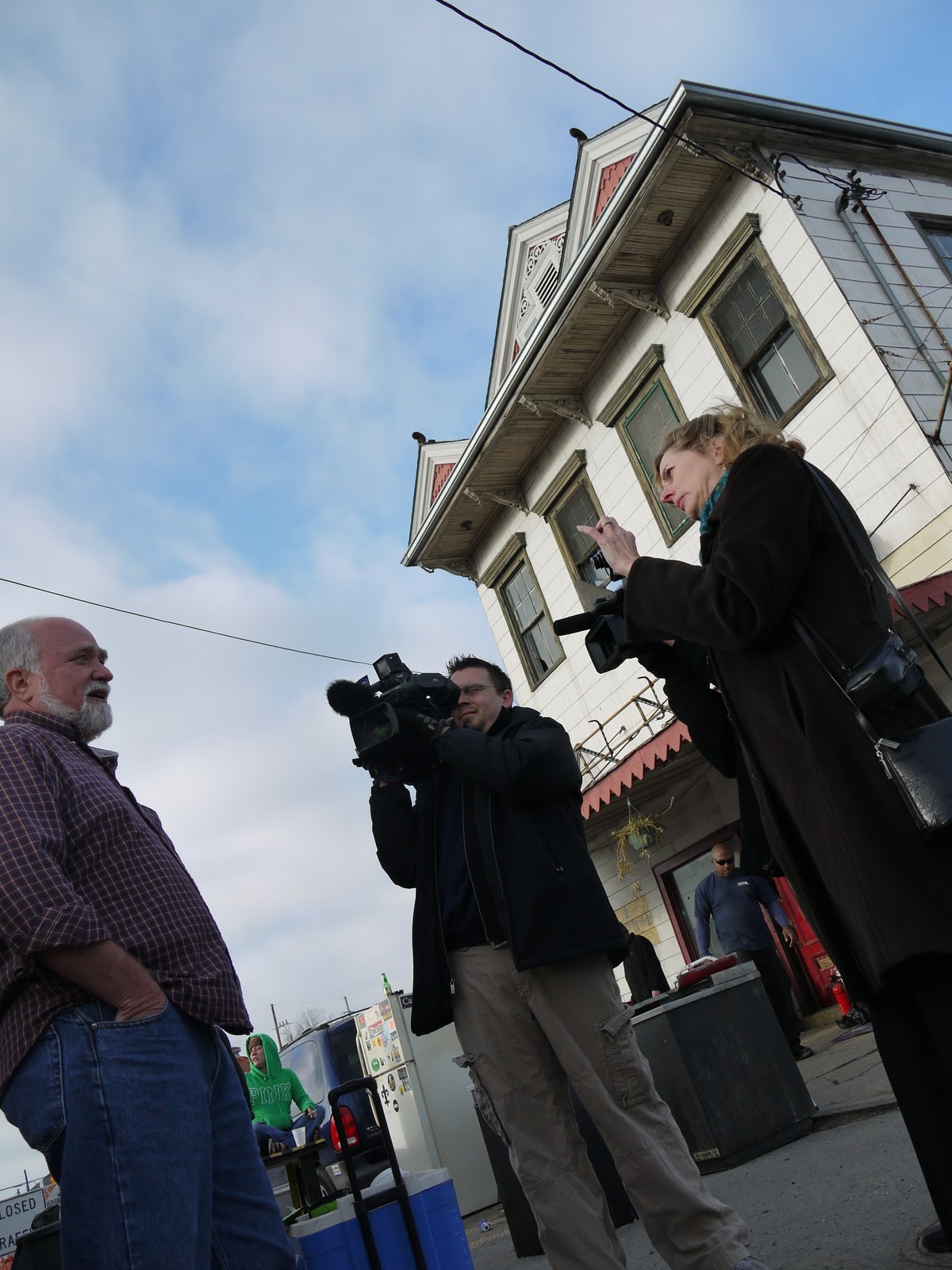
The owner, Greg Guth, an attorney, stood outside shortly after I arrived, a moving truck behind him, and gave a reasoned explanation of why he believes he retains legal rights (30 days to file an appeal to the Lousiana Supreme Court) to the building and the tavern operation the occupied it. While many items had apparently been moved out of the bar by the constables who arrived earlier in force, when I arrived, patrons of the bar moved some items out of the bar and moved everything into the truck as a number of contractors and police officers looked on.

An intense scene emerged as contractors ultimately started drilling the doors shut with boards. Nicole, the bartender and manager of the bar, got in the faces of the workers as the last screws drove into the wood. It really was a crazy scene.

And then, amidst the piles of items from the bar and the gathered, shocked, almost tearful patrons, it was done. Louis, who mans the BBQ on Saints game days, who once shined shoes at the bar when he was ten with his father (many different bar names ago), hauled away the plant that stood sentinel out front.

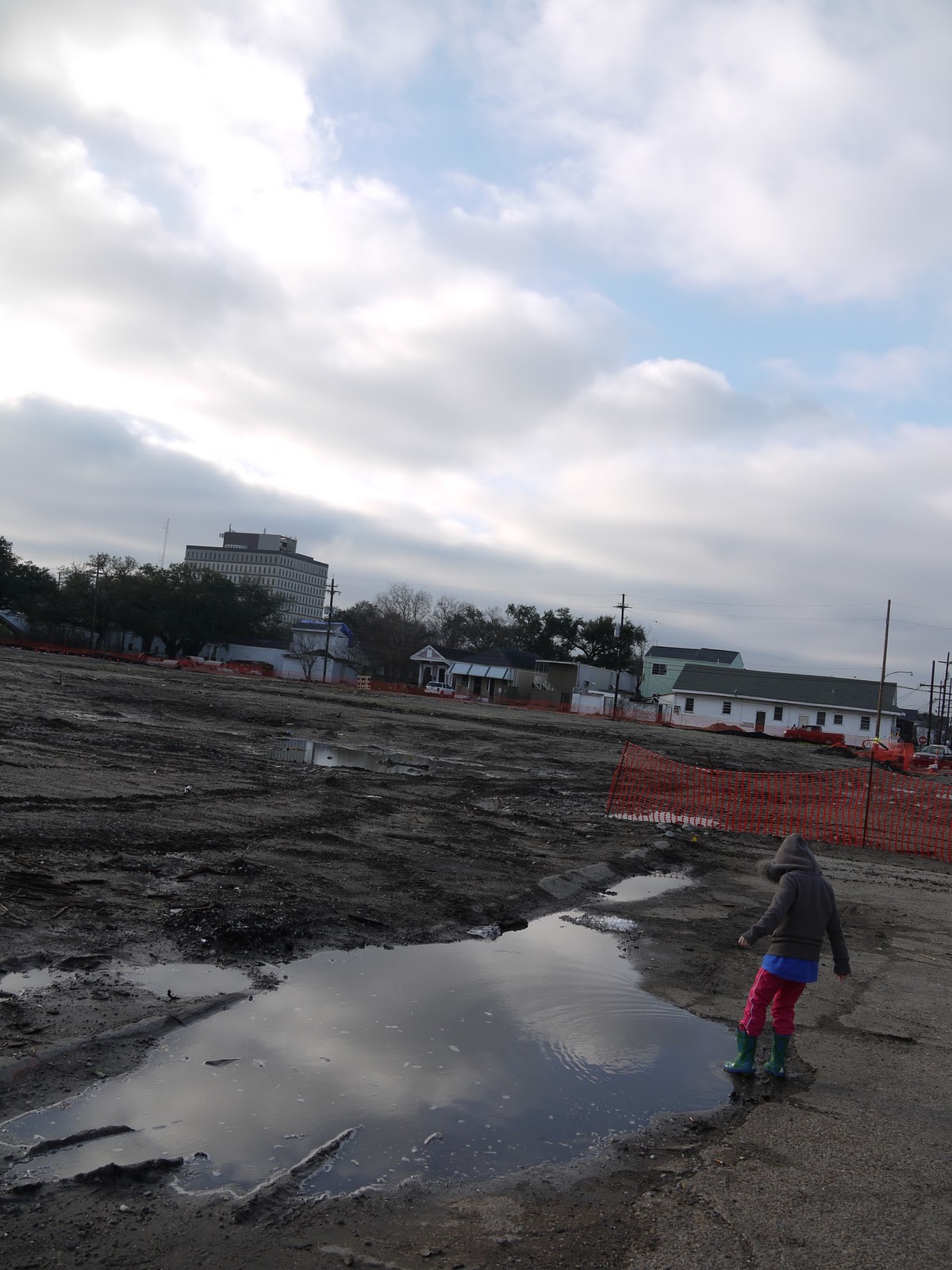
The State of Louisiana made clear today what's been rather clear to me all along. They're not going to play nice.
ADDED:
Here's the AP's story on the happening as it appeared at Nola.com.
Demolition Continues Unchecked in LSU Footprint

1925 Cleveland Avenue, shown above after salvage was underway, was demolished on Friday in the LSU Footprint.

The man who lived in the house, who owned a dog, as I recall. "Ooh, he did NOT want to leave," a neighbor noted from across the street, looking on as a crew worked to pull out an ornate metal fencepost.
She said she's leaving the city since she has to move. She's moving to the country.
This morning, around the corner, the beautiful shotgun at 218 S. Prieur was demolished.

Its demolition demonstrates concretely that the State of Lousiana, and the Division of Facilities and Planning in particular, really have no intention of participating in a house moving effort, despite what Jerry Jones has said on multiple occasions. It also illustrates an inability of the City of New Orleans to extract positives from the situation.
A private party recently reached out to offer to take eight houses off the site. When I mentioned this to someone on site, I was told that it would likely not be possible because there are "time issues." Time issues? The only time issues are those self-imposed by the state and its contractors because they have to continue demolishing buildings to make the complete razing of the site seem inevitable before anyone can stop them with the pile of nagging concerns that exist - like inadequate financing to build the proposed hospital.
Over a dozen buildings, many of them contributing historic properties, have been demolished in the LSU Footprint to date.

Sunday, January 9, 2011
Blast from the Past

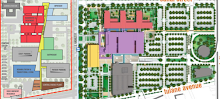
This image appeared in the 2006 LSU Health Care Services Division's Annual Report. It shows something closer to an actual "joint" hospital venture between LSU and the VA in a single site, all of which is below S. Galvez, occupying what is now the proposed UMC site in what's come to be known as the LSU Footprint.
At some point in early 2007, the VA Hospital site "jumped" S. Galvez into a far more inappropriate location and ultimately led to the bulk of the large scale devastation and displacement that has played out thus far.
Note the taller buildings and the giant, vertical structure in the spot that is currently occupied by the Grand Palace Hotel building that's labeled "Parking Garage."
Note, too, the overly optimistic timeline. As things stand at this point, neither the VA nor the LSU facility will open in 2011.
Subscribe to:
Posts (Atom)