Friday, September 17, 2010
"Crews are swarming around the next two houses"
At Nola.com, R. Stephanie Bruno peruses the diverse architecture of the homes on one block of Palmyra Street...that's on the brink.


Thursday, September 16, 2010
Gritty

Some of the houses, as you see here with the work from today, get rather roughed up as an incident of the moving preparation. A number of houses, including the last two shown here, are scheduled to move out of the Footprint tomorrow.


Moving Out

Today was very clearly moving day across the VA Footprint - not houses themselves, but people moving out of houses.

A large truck pulled up in front of Gayle Ruth's beautiful home on S. Tonti, catching a bit of the mud left from the remnants of its neighbor's foundation.

Below S. Tonti, a family on Cleveland was moving out. Above S. Tonti, the same. A lady sitting on a third porch down the way observed bitterly that her daughter, who lives at the address, received notice to move out in 30 days, but didn't know what to do.
A Modernist Morsel

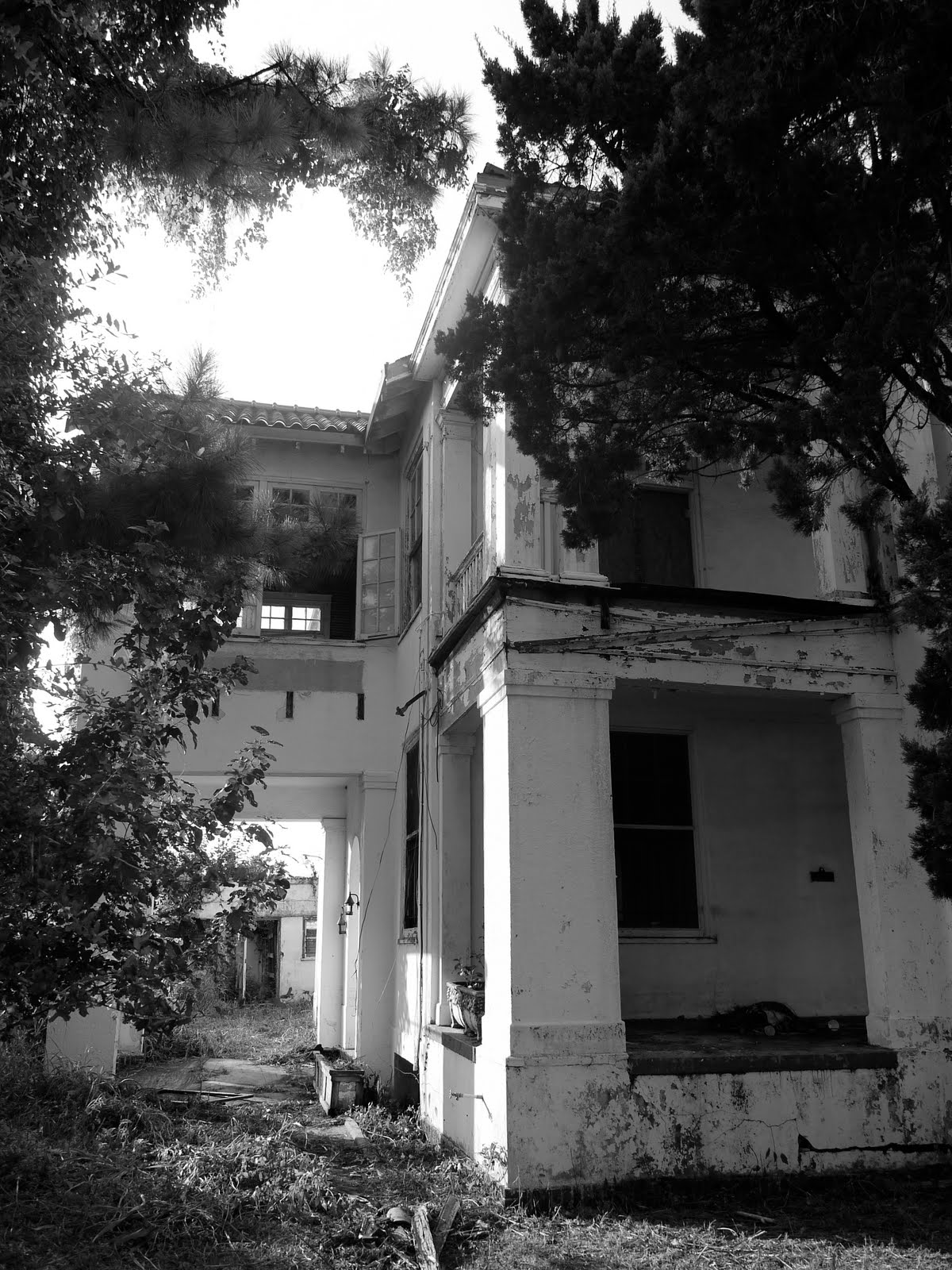
Until now, I've never mentioned or photographed this building on Banks just below Galvez in the LSU Footprint. It's the former office of an obstetrician and gynecologist. And it looks like someone really should call the local chapter of DOCOMOMO and get them involved.

I'm not the world's biggest fan of modernist architecture. But if this fight has taught me nothing else, it's taught me that the destruction of large swaths of neighborhood has all sorts of collateral damage - and that sometimes even if something doesn't matter to you, it might be the highest form in another person's mind.

UMC Board Meeting Notes
I attended a portion of the UMC Board meeting this afternoon.
As far as public input goes, a new policy, announced in the agenda, requires that anyone seeking public comment must sign up one half hour before the meeting and speak only to those topics on the agenda. This effectively preempted public input.
A few interesting issues emerged as the board met with J.P. Morgan Chase regarding financing in the basement of the LSU Interim University Hospital:
1. Is Causey, Demgen, and Moore, Inc., the "independent" party being brought in to review the feasibility of LSU's University Medical Center in the LSU Footprint actually independent? It appears that LSU is paying it...and somehow it's independent because it's doing the study for the UMC. The elephant in the room at the meeting: isn't that obviously a conflict of interest? The lawyer on hand was called upon to opine as soon as it became a bit too awkward.
The independence of the review is relevant to whether or not UMC could obtain insurance for the project via FHA under HUD, as opposed to going the route of seeking funds in the private bond market, a more treacherous undertaking (sorry for the acronyms - if you don't know what they are, there's a good chance you probably haven't read this far anyway).
2. Where are the patients going to come from that will fill the expanded 424-bed facility? One of the board members, Mr. Volkert, asked this legitimate question. It also became clear that it's difficult to predict any numbers along those lines clearly given the uncertain impact of Obamacare.
3. If the application for HUD insurance fails...what then? Only 25% of applications are accepted by HUD. One board member, Ms. Abell, asked how such a rejection would affect UMC's ability to then turn around and seek to go down the private bond market route. Nobody really answered, but the impression seemed to be that the prospects in the bond market would not be good if the application failed even the easier HUD route.
4. Site preparation for the LSU Footprint is slated to begin in November.
That's what I can report from observing nearly 2 hours worth of the meeting, but it wasn't over when I left.
As far as public input goes, a new policy, announced in the agenda, requires that anyone seeking public comment must sign up one half hour before the meeting and speak only to those topics on the agenda. This effectively preempted public input.
A few interesting issues emerged as the board met with J.P. Morgan Chase regarding financing in the basement of the LSU Interim University Hospital:
1. Is Causey, Demgen, and Moore, Inc., the "independent" party being brought in to review the feasibility of LSU's University Medical Center in the LSU Footprint actually independent? It appears that LSU is paying it...and somehow it's independent because it's doing the study for the UMC. The elephant in the room at the meeting: isn't that obviously a conflict of interest? The lawyer on hand was called upon to opine as soon as it became a bit too awkward.
The independence of the review is relevant to whether or not UMC could obtain insurance for the project via FHA under HUD, as opposed to going the route of seeking funds in the private bond market, a more treacherous undertaking (sorry for the acronyms - if you don't know what they are, there's a good chance you probably haven't read this far anyway).
2. Where are the patients going to come from that will fill the expanded 424-bed facility? One of the board members, Mr. Volkert, asked this legitimate question. It also became clear that it's difficult to predict any numbers along those lines clearly given the uncertain impact of Obamacare.
3. If the application for HUD insurance fails...what then? Only 25% of applications are accepted by HUD. One board member, Ms. Abell, asked how such a rejection would affect UMC's ability to then turn around and seek to go down the private bond market route. Nobody really answered, but the impression seemed to be that the prospects in the bond market would not be good if the application failed even the easier HUD route.
4. Site preparation for the LSU Footprint is slated to begin in November.
That's what I can report from observing nearly 2 hours worth of the meeting, but it wasn't over when I left.
The Destination Locations

All along lower Bienville Avenue, the VA Footprint houses are springing up under the live oaks, transforming the corridor in a notable way.

Subcontractors for Tim Clark Construction were already busy at work yesterday, constructing foundation piers to receive the houses. Five of the moved homes now line various blocks of Bienville below N. Galvez Street.


Relevant Meetings Today
1. UMC Board - 1 p.m. - basement of LSU Interim Hospital - Details of LSU's attempt to finance its proposed University Medical Center (the LSU Footprint).
2. GNOBEDD (BioDistrict) - 6 p.m. - Xavier Student Center - Provide input on the nature of the BioScience District. If you thought the LSU/VA Footprint was excessive, take a look at this one. In shaping its plan, the district needs to adopt a more modest set of geographic boundaries and focus its energies on the many vacancies in the existing Medical District (inside the CBD) instead of expanding into Mid-City.
2. GNOBEDD (BioDistrict) - 6 p.m. - Xavier Student Center - Provide input on the nature of the BioScience District. If you thought the LSU/VA Footprint was excessive, take a look at this one. In shaping its plan, the district needs to adopt a more modest set of geographic boundaries and focus its energies on the many vacancies in the existing Medical District (inside the CBD) instead of expanding into Mid-City.
Wednesday, September 15, 2010
Four Houses Moving Today

According to a neighbor, 2322 Palmyra, was one of the first homes in the neighborhood purchased by an African American in the 1960s. Ms. Williams, who now lives in Texas, sold the home she bought decades ago, but was very surprised out to find out from the neighbor that it was moving today.

This 4-bay double shotgun house, en route from S. Tonti, was the widest house moved off the site to date.

Residents watched from porches on Palmyra as the houses lined up for the move.

A portion of the large moving crew broke for a quick lunch prior to the move.


Tuesday, September 14, 2010
People in the 'print

While the VA Footprint site grows a bit more empty with each passing week, it's important to note that residents, like the girl above, returning home from school today, still live in the neighborhood.

People still attempt to pass through the area, as on this stretch of S. Tonti Street, as part of their daily lives. Two houses on Tonti are ready for moving; crews on the site noted that four houses are presently slated to move tomorrow, Wednesday. Four more are slated to move out on Friday.

And some people are in the midst of transition, like this lady, who saw my camera recently, requested a photo shoot, and struck a pose amidst the drudgery of a hot moving day to make light of the whole process. Her household, I was told, isn't moving far away, as it wants to remain in the area.
227-29 S. Miro Street

This 4-bay shotgun on S. Miro lost a portion of its facade and its side wall today. I'll check to see what that means.
As with several houses that have been opened up to the outside, it's strange to see the artifacts of home life left suspended - like the Warren Easton graduation certificate that's still on the wall in the shot below.

My Favorite Camelback

One of my favorite camelbacks, and one of my favorite overall houses in the VA Footprint began preparation for a move today. I hope the crews and the architect working on the refurbishment designs for the new site do as much as possible to retain the unique characteristics of the building.
Here's the description from Ms. Sally Reeves:
Classical-revival-style 3-bay camelback with side gallery, front gallery, and elaborated with heavy cornice, paired brackets, modelions, and parapet. Recessed side entry; bayed front.
Monday, September 13, 2010
Today's Update

Crews started in on this 3-bay shotgun at 309 S. Galvez today, preparing it for a move.

Wally Thurman stopped by S. Tonti Street to check up on his house. The house across the street and the house next door, 223 S. Tonti, (blue, below) were both being prepared for moving.

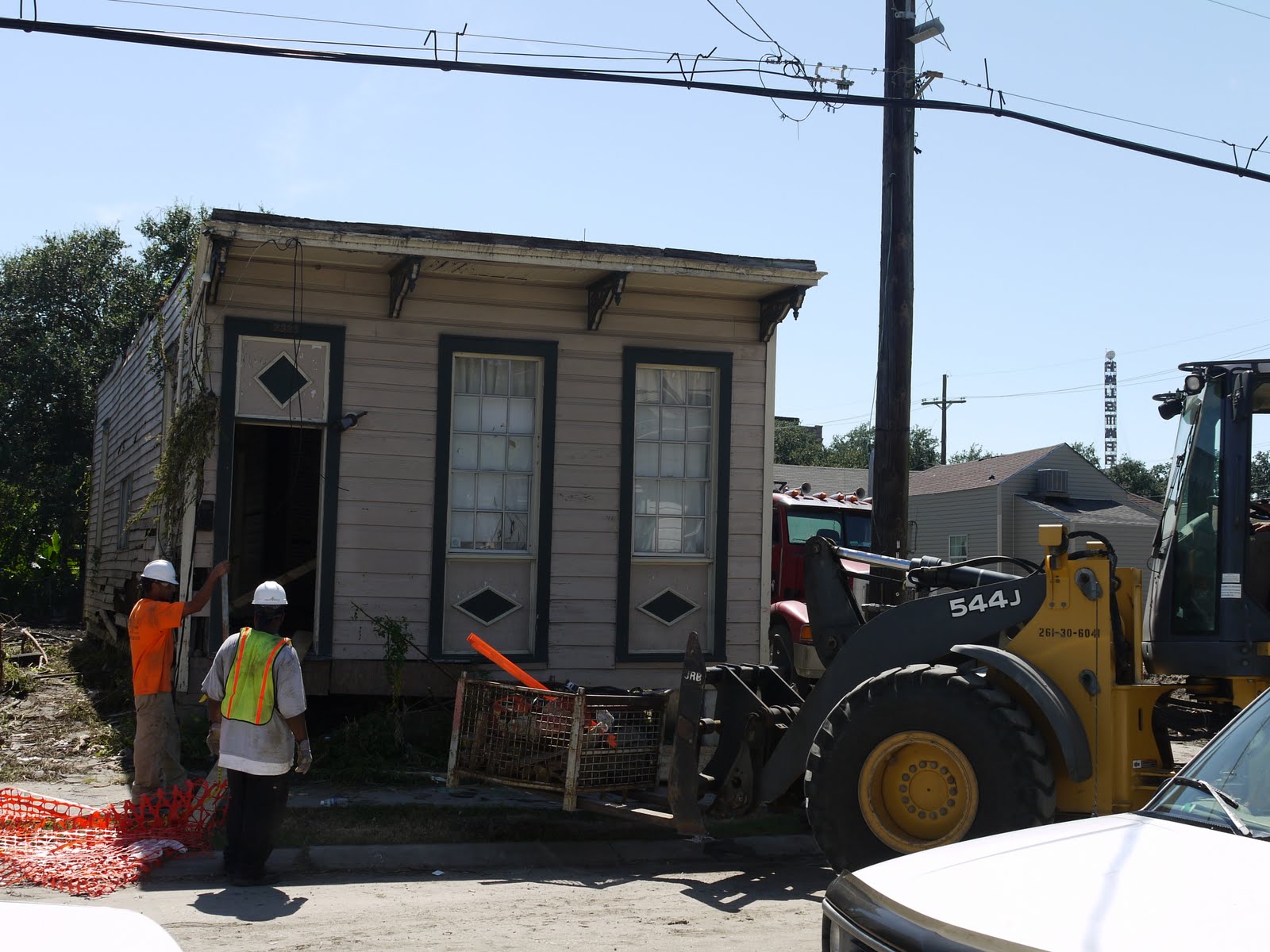
Crews also continued work today on this house at 2326 Palmyra Street.

Farther down the street, the house at 2224 Palmyra was also being prepared for moving.

The final development, pictured below, is perhaps the most interesting of the day. Handbills appeared on doorknobs throughout the VA Footprint announcing "A new BioScience District is coming to your area."

'What does this mean for you?', it asks rhetorically, answering in part with a "revitalized Mid-City."
What it doesn't mention - and what makes it rather creepy and disturbing - is that the GNOBEDD plans, in their vision of a "revitalized Mid-City", would require the demolition and destruction of much of Mid-City as we know it - and not just Lower Mid-City. Thus, the placement of these disingenuous fliers really is quite a final salt-in-the-wounds insult to the people that remain inside the VA Footprint.
Like the hospitals project, the 1,500-acre BioDistrict is not a wonderful, benevolent stranger to invite into the neighborhood. The euphemistic language hides the fact that the development of the BioDistrict with its claims of a "land bank" require neglecting to mention that thousands of people live in hundreds of historic homes in the enormous footprint for the proposed project.
It's unfortunate that I have to warn against GNOBEDD. Usually, I'd be welcoming this sort of development. I would have no problem if it was trying to redevelop the many vacant skyscrapers in the CBD. Usually I would see its push for high paying jobs as a plus.
But then again, usually the powers that be would not be quite as brazen in their disregard for the irreplaceable historic communities at the heart of their metropolitan region. Usually they'd be a little more savvy and a little less cunning.
ADDED: Last evening, I had a chance to look at the GNOBEDD AECOM Draft, a study of the Biodistrict. To substantiate my assertion above about the likely damage to Mid-City, here's a screen shot near the end of the report that hints at the desire for a sizable land grab:

The fact that there's a district at all begs the question - why not simply trumpet the existing health and science nodes at either end? Combine that with regret over the lack of eminent domain authority, and it's difficult to see how existing Mid-City neighborhoods - in the Mid-City National Register Historic District - aren't the largely unspoken target.
The report also notes the many vacancies in both major structures and land in the historic Medical District in the CBD. That, too, begs the question - why the need for a district expanding out into Mid-City when there are so many possibilities in the existing Medical District in the CBD? Here's a look at the working paper:


A Comprehensive Look at the House Moving Process
Orleans Shoring, one of the main contractors involved in the house moves, sent along a link to an extensive bank of photos documenting the entire process involved in the first few house moves from the VA Footprint.
The photos do a better job than my own posts in demonstrating just how labor intensive the house moving process can be (especially given the age of some structures).
The photos do a better job than my own posts in demonstrating just how labor intensive the house moving process can be (especially given the age of some structures).
Saturday, September 11, 2010
Expropriation - A Look at Government Takings in the LSU/VA Hospitals Footprint
In Louisiana's civil law-based legal system, eminent domain goes by another name: expropriation.
Back in March, the first expropriation of property in the VA Footprint by the LSU Board of Supervisors, the former Pan-Am Building on Canal, caused a stir. But what's been happening expropriation-wise in the hospital site since that time?
Yesterday, I went to the clerk's office at Civil District Court here in New Orleans. A would-be expropriating party must file a petition and deposit a check with the court and obtain an order, among other things, when seizing property.
It turns out LSU has expropriated over 50 properties in New Orleans since May 1 of this year. There were so many petitions that I could not confirm (before the office closed for the day) that every last one of them was a property inside the LSU/VA hospitals footprint, but many of the party names indicated LLCs set up to run properties at addresses inside the footprint. And I'm not aware of any other major LSU expropriation target sites in the parish.
Fortunately, Bill Barrow's piece in the Times-Picayune on yesterday's press house moving conference noted that the developing parties "have filed dozens of expropriations on properties whose owners have not accepted the government's offering price."
I hope someone from the paper takes an extensive look at the expropriations - it's a task that requires some significant investigative effort (if anyone needs the case id numbers to pursue this further, I can share them, which would save a good deal of time in the clerk's office).
The widespread use of takings in this process further reinforces the analogy to the aftermath of the situation in New London, Connecticut in the Kelo case, especially given the uncertainty of LSU's ability to obtain the funds necessary for its part of the new hospital complex. As in Kelo, we now have a situation where government takings may be used on a large scale against private property owners...and there's a significant question whether the intended goal project will be built at all.
Expropriating - literally the heavy hand of government forcing a private property owner of his or her land - for acres of surface level parking lots is bad enough. Expropriating for nothing is even worse.
Back in March, the first expropriation of property in the VA Footprint by the LSU Board of Supervisors, the former Pan-Am Building on Canal, caused a stir. But what's been happening expropriation-wise in the hospital site since that time?
Yesterday, I went to the clerk's office at Civil District Court here in New Orleans. A would-be expropriating party must file a petition and deposit a check with the court and obtain an order, among other things, when seizing property.
It turns out LSU has expropriated over 50 properties in New Orleans since May 1 of this year. There were so many petitions that I could not confirm (before the office closed for the day) that every last one of them was a property inside the LSU/VA hospitals footprint, but many of the party names indicated LLCs set up to run properties at addresses inside the footprint. And I'm not aware of any other major LSU expropriation target sites in the parish.
Fortunately, Bill Barrow's piece in the Times-Picayune on yesterday's press house moving conference noted that the developing parties "have filed dozens of expropriations on properties whose owners have not accepted the government's offering price."
I hope someone from the paper takes an extensive look at the expropriations - it's a task that requires some significant investigative effort (if anyone needs the case id numbers to pursue this further, I can share them, which would save a good deal of time in the clerk's office).
The widespread use of takings in this process further reinforces the analogy to the aftermath of the situation in New London, Connecticut in the Kelo case, especially given the uncertainty of LSU's ability to obtain the funds necessary for its part of the new hospital complex. As in Kelo, we now have a situation where government takings may be used on a large scale against private property owners...and there's a significant question whether the intended goal project will be built at all.
Expropriating - literally the heavy hand of government forcing a private property owner of his or her land - for acres of surface level parking lots is bad enough. Expropriating for nothing is even worse.
The Next Five Moves
The Times-Picayune lists the first 11 house moves with a map of the moves. With six complete, the final five listed are the next to go.
Friday, September 10, 2010
Elsewhere in the Footprint Today

Demolition finished on the house at 323-25 S. Miro.

Moving prep seemingly got underway on a small creole cottage-style home on Cleveland just above S. Galvez.
It was not deemed a contributing property, but it very clearly has old bones as the crew revealed when I stopped by to watch.

Mrs. Ruth Sanderson, a local resident, watched the commotion on Palmyra Street as the houses moved down toward the river. She noted that she has yet to finalize her arrangements regarding her property.

Crews also set to work on this 3-bay shotgun at 2322 Palmyra, which has become overgrown in the past three summer months.
TP Photos of the House Moving Press Conference
Here's the slideshow.
The only inaccurate part is the statement that these were the "first houses moved" off the site. The first ones moved on Wednesday, as reported here.
The only inaccurate part is the statement that these were the "first houses moved" off the site. The first ones moved on Wednesday, as reported here.
The Mayor Comes to the Footprint

Briefly, some were happy, some were not. The house moving itself did not appear to be the object of contention, but rather the wider plan and developments that brought things to this point.


Afterward, 2426 Palmyra (and two other houses) headed down Palmyra as the large crowd dispersed gradually - making its way to a spot on St. Louis Street along the future Lafitte Greenway.




Subscribe to:
Posts (Atom)