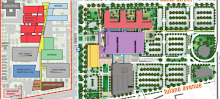
I know of at least two suits that have been filed recently by property owners in the LSU Footprint that challenge not merely the amount of compensation for expropriated property, but other aspects of the takings as well.
For example, here's the opening of The Blood Center's attempt to impose a Temporary Restraining Order (TRO) and obtain injunctive relief:
Somewhat ironically, I know that a number of former residents of the LSU Footprint saw the Blood Center take over properties in the neighborhood...removing houses from two full squares of the neighborhood, making part of it "green space," and doing little with much of the property after Katrina. As with just about any aspect of activities and controversies in the Footprint, things are complicated.
Additionally, a property owner on Cleveland Avenue has filed a suit that directly challenges the legality of the government taking, the expropriation by the LSU Board of Supervisors. The City of New Orleans is also named as a defendant.
Here is a sampling:
Showing posts with label Kelo. Show all posts
Thursday, April 21, 2011
Thursday, November 11, 2010
A Shoutout
Jeff Benedict, who wrote the book Little Pink House (which chronicles the Kelo decision), mentioned Inside the Footprint on his blog today.
Thursday, November 4, 2010
Making A Pitch
I would highly encourage anyone concerned about unwise use of eminent domain - and loss of historic structures as a result of it - to consider attending a presentation in Baton Rouge next week.
My friend Sandra Stokes works with the FHL, and I'm glad the group is bringing in such a timely speaker. The Kelo experience does tie into the experience in Lower Mid-City, where dozens upon dozens of properties - including historic buildings and functioning businesses - have been expropriated needlessly.
Labels:
book signings,
expropriation,
Kelo,
law,
lectures,
Little Pink House
Monday, September 20, 2010
Treading in Dangerous Waters
Today's Times-Picayune piece demonstrates just how fundamentally flawed the plans are for the proposed UMC Hospital, in what I've long called the LSU Footprint.
Mayor Landrieu, at the very least, called for changes to the UMC design, and some of those changes - adding street-level retail space, maintaining at least some of the Mid-City street grid and reducing the amount of surface parking on the 34-acre University Medical Center campus - would be positive.
But they're borderline meaningless in the big picture - the neighborhood is still being destroyed. And I'm not using that word lightly. When I say destroyed, I mean literally destroyed. By the state government with the complicity of the city government. And I know of no plan to move the houses on the LSU side, so at present, well over 50 historic homes (not just in my view, but as determined by the Programmatic Agreement for the hospitals) are headed for the landfill. Like this one:
That brings me to the other aspect of the LSU Footprint that Bill Barrow managed to highlight as he confronted the city's Andy Kopplin and the Division of Adminstration's Michael Diresto: LSU is even now expropriating land only to have it sit or have it go to a private entity. Not incidentally or accidentally, but purposefully. Barrow noted the possible problem with the state's Constitutional Amendment, passed as a result of Kelo:
I'm not so sure. See Section 4 of Article 1 of the Louisiana Constitution as amended in 2006: Except as specifically authorized by Article VI, Section 21 of this Constitution property shall not be taken or damaged by the state or its political subdivisions: (a) for predominant use by any private person or entity; or (b) for transfer of ownership to any private person or entity.
There's also the added state constitutional requirement that in addition to being entailing a public purpose, the expropriation must be necessary: "(4) Property shall not be taken or damaged by any private entity authorized by law to expropriate, except for a public and necessary purpose and with just compensation paid to the owner; in such proceedings, whether the purpose is public and necessary shall be a judicial question." [bold and ital. mine]
I've noticed that the LSU expropriation petitions on file with the CDC clerk contain affidavits by some shameless figure named Kim Way from Columbus, Ohio asserting that the amount taken is appropriate for the project.
LSU should know that such actions are at the root of the nation-wide backlash against the Kelo decision, an opinion reviled by figures across the political spectrum.
Finally, why is the default in this situation an overwhelming deference to LSU? It's evident again in the mistreatment of homeowners and operating business owners - like Cal at Broadmoor Auto Parts on Banks Street, which struggled as it was to come back after Katrina:
It should happen. There's still so much uncertainty about whether LSU will be able to fund its proposed medical center that expropriation of properties to drive people and businesses out is truly sinister. It's nothing short of un-American for the government to take property when it's not at all clear that the land seized will actually be used for a public purpose.
Mayor Landrieu, at the very least, called for changes to the UMC design, and some of those changes - adding street-level retail space, maintaining at least some of the Mid-City street grid and reducing the amount of surface parking on the 34-acre University Medical Center campus - would be positive.
But they're borderline meaningless in the big picture - the neighborhood is still being destroyed. And I'm not using that word lightly. When I say destroyed, I mean literally destroyed. By the state government with the complicity of the city government. And I know of no plan to move the houses on the LSU side, so at present, well over 50 historic homes (not just in my view, but as determined by the Programmatic Agreement for the hospitals) are headed for the landfill. Like this one:
That brings me to the other aspect of the LSU Footprint that Bill Barrow managed to highlight as he confronted the city's Andy Kopplin and the Division of Adminstration's Michael Diresto: LSU is even now expropriating land only to have it sit or have it go to a private entity. Not incidentally or accidentally, but purposefully. Barrow noted the possible problem with the state's Constitutional Amendment, passed as a result of Kelo:
One challenge of creating more retail space is conforming to state laws that limit the private use of land that is expropriated for public purpose. Similar considerations could come into play if the project depends on federal mortgage insurance to back construction bonds.
...
The state appears to have no intention of slowing its land acquisition process, and its contractors have filed dozens of expropriation orders on parcels in the footprint. That could still leave several city blocks of empty, unused land, even if the street grid on those blocks is reopened.
Kopplin said the city believes that "auxiliary services" that are directly connected to the UMC mission -- pharmacies, medical suppliers, flower shops, restaurants -- should clear any legal obstacles.
I'm not so sure. See Section 4 of Article 1 of the Louisiana Constitution as amended in 2006: Except as specifically authorized by Article VI, Section 21 of this Constitution property shall not be taken or damaged by the state or its political subdivisions: (a) for predominant use by any private person or entity; or (b) for transfer of ownership to any private person or entity.
There's also the added state constitutional requirement that in addition to being entailing a public purpose, the expropriation must be necessary: "(4) Property shall not be taken or damaged by any private entity authorized by law to expropriate, except for a public and necessary purpose and with just compensation paid to the owner; in such proceedings, whether the purpose is public and necessary shall be a judicial question." [bold and ital. mine]
I've noticed that the LSU expropriation petitions on file with the CDC clerk contain affidavits by some shameless figure named Kim Way from Columbus, Ohio asserting that the amount taken is appropriate for the project.
LSU should know that such actions are at the root of the nation-wide backlash against the Kelo decision, an opinion reviled by figures across the political spectrum.
Finally, why is the default in this situation an overwhelming deference to LSU? It's evident again in the mistreatment of homeowners and operating business owners - like Cal at Broadmoor Auto Parts on Banks Street, which struggled as it was to come back after Katrina:
The Goody Clancy report also raised the idea of not expropriating land on the Claiborne side of the footprint if the parcel is now occupied by a working business. Kopplin said that issue has come up in the city-state discussions. He cited other public development projects in which a public entity agreed to a conditional purchase of private property, allowing a business or homeowner to remain on the land for a certain period of time until the parcel is actually needed.
"I'm not saying that's going to happen in this case, but we're at least asking the questions," Kopplin said.
It should happen. There's still so much uncertainty about whether LSU will be able to fund its proposed medical center that expropriation of properties to drive people and businesses out is truly sinister. It's nothing short of un-American for the government to take property when it's not at all clear that the land seized will actually be used for a public purpose.
Saturday, September 11, 2010
Expropriation - A Look at Government Takings in the LSU/VA Hospitals Footprint
In Louisiana's civil law-based legal system, eminent domain goes by another name: expropriation.
Back in March, the first expropriation of property in the VA Footprint by the LSU Board of Supervisors, the former Pan-Am Building on Canal, caused a stir. But what's been happening expropriation-wise in the hospital site since that time?
Yesterday, I went to the clerk's office at Civil District Court here in New Orleans. A would-be expropriating party must file a petition and deposit a check with the court and obtain an order, among other things, when seizing property.
It turns out LSU has expropriated over 50 properties in New Orleans since May 1 of this year. There were so many petitions that I could not confirm (before the office closed for the day) that every last one of them was a property inside the LSU/VA hospitals footprint, but many of the party names indicated LLCs set up to run properties at addresses inside the footprint. And I'm not aware of any other major LSU expropriation target sites in the parish.
Fortunately, Bill Barrow's piece in the Times-Picayune on yesterday's press house moving conference noted that the developing parties "have filed dozens of expropriations on properties whose owners have not accepted the government's offering price."
I hope someone from the paper takes an extensive look at the expropriations - it's a task that requires some significant investigative effort (if anyone needs the case id numbers to pursue this further, I can share them, which would save a good deal of time in the clerk's office).
The widespread use of takings in this process further reinforces the analogy to the aftermath of the situation in New London, Connecticut in the Kelo case, especially given the uncertainty of LSU's ability to obtain the funds necessary for its part of the new hospital complex. As in Kelo, we now have a situation where government takings may be used on a large scale against private property owners...and there's a significant question whether the intended goal project will be built at all.
Expropriating - literally the heavy hand of government forcing a private property owner of his or her land - for acres of surface level parking lots is bad enough. Expropriating for nothing is even worse.
Back in March, the first expropriation of property in the VA Footprint by the LSU Board of Supervisors, the former Pan-Am Building on Canal, caused a stir. But what's been happening expropriation-wise in the hospital site since that time?
Yesterday, I went to the clerk's office at Civil District Court here in New Orleans. A would-be expropriating party must file a petition and deposit a check with the court and obtain an order, among other things, when seizing property.
It turns out LSU has expropriated over 50 properties in New Orleans since May 1 of this year. There were so many petitions that I could not confirm (before the office closed for the day) that every last one of them was a property inside the LSU/VA hospitals footprint, but many of the party names indicated LLCs set up to run properties at addresses inside the footprint. And I'm not aware of any other major LSU expropriation target sites in the parish.
Fortunately, Bill Barrow's piece in the Times-Picayune on yesterday's press house moving conference noted that the developing parties "have filed dozens of expropriations on properties whose owners have not accepted the government's offering price."
I hope someone from the paper takes an extensive look at the expropriations - it's a task that requires some significant investigative effort (if anyone needs the case id numbers to pursue this further, I can share them, which would save a good deal of time in the clerk's office).
The widespread use of takings in this process further reinforces the analogy to the aftermath of the situation in New London, Connecticut in the Kelo case, especially given the uncertainty of LSU's ability to obtain the funds necessary for its part of the new hospital complex. As in Kelo, we now have a situation where government takings may be used on a large scale against private property owners...and there's a significant question whether the intended goal project will be built at all.
Expropriating - literally the heavy hand of government forcing a private property owner of his or her land - for acres of surface level parking lots is bad enough. Expropriating for nothing is even worse.
Labels:
eminent domain,
expropriation,
Kelo,
law,
LSU,
LSU/VA Hospital,
New Orleans,
takings
Tuesday, November 3, 2009
Times-Picayune Gets it Wrong on the VA Hospital
After news broke yesterday that the VA site wouldn't be cleared until summer of 2010, the paper's editorial board offered its unequivocal support for hastening the process of preparing the site of the proposed VA hospital in "downtown" New Orleans, by which it appears to mean Lower Mid-City.
It's unfortunate that the board utterly failed to qualify its stance.
While pretty much everyone agrees that a new VA hospital would be a good thing for New Orleans and for veterans, it's disturbing to see no mention whatsoever of other concerns in the editorial. There's not a single mention of another interest in play: the rights and treatment of residents of Lower Mid-City. The editorial is wildly imbalanced in this regard.
What the board fails to understand is that the lack of progress in acquiring properties it laments has some underlying sources. For one, as a state historic preservation official stated recently in a speaking engagement at Tulane, there are only two properties in the VA footprint that are actually looking at moving at this point given all the complications. This is not just some issue that can be overcome by applying greater willpower - it's an intractable problem.
Let's not forget that there are residents who have made it clear that they will fight to the bitter end. Making the VA footprint "construction-ready" will require full-out expropriation by means of eminent domain in the end. The board's editiorial fails to address the negative consequences of having to resort to that remedy - even if that tenuous option is arguably constitutional after the unfortunate Kelo case. There's still the Louisiana constitutional amendment, passed post-Kelo, to keep in mind:
It's unfortunate that the board utterly failed to qualify its stance.
While pretty much everyone agrees that a new VA hospital would be a good thing for New Orleans and for veterans, it's disturbing to see no mention whatsoever of other concerns in the editorial. There's not a single mention of another interest in play: the rights and treatment of residents of Lower Mid-City. The editorial is wildly imbalanced in this regard.
What the board fails to understand is that the lack of progress in acquiring properties it laments has some underlying sources. For one, as a state historic preservation official stated recently in a speaking engagement at Tulane, there are only two properties in the VA footprint that are actually looking at moving at this point given all the complications. This is not just some issue that can be overcome by applying greater willpower - it's an intractable problem.
Let's not forget that there are residents who have made it clear that they will fight to the bitter end. Making the VA footprint "construction-ready" will require full-out expropriation by means of eminent domain in the end. The board's editiorial fails to address the negative consequences of having to resort to that remedy - even if that tenuous option is arguably constitutional after the unfortunate Kelo case. There's still the Louisiana constitutional amendment, passed post-Kelo, to keep in mind:
‘property shall not be taken or damaged by the state or its political subdivisions: for predominant use by any private person or entity; or for transfer of ownership to any private person or entity,’ (La Const. Art. I § 4(B)(1)).”
Labels:
expropriation,
Kelo,
law,
Times-Picayune,
VA hospital
Subscribe to:
Posts (Atom)