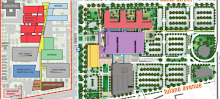
Yesterday, the City Planning Commission approved the eventual closure of a number of the streets inside the planned VA footprint. The Times-Pic article on the subject does not say when the closures would actually begin - seemingly a crucial fact.
The City Council vote on the matter is the next step.
Wednesday, February 24, 2010


Monday, February 22, 2010
Tomorrow, February 23
The New Orleans City Planning Commission is slated to consider, at the least, the closure of cross-streets inside the VA footprint:
The meeting is scheduled for 1:30 p.m. at City Hall in the Council Chambers.
In question are the cross streets bounded by South Rocheblave Street, Tulane Avenue, South Galvez Street and Canal Street. Thoroughfares on the state site -- across Galvez to South Claiborne Avenue, also bounded by Tulane and Canal -- are not on the agenda.
The meeting is scheduled for 1:30 p.m. at City Hall in the Council Chambers.
Sunday, February 21, 2010
Interesting
I noticed a hyperlinked ad atop the Nola.com homepage that linked to Canal Housing, a company that owns and rents a number of small properties inside the footprint, all apparently restored after Katrina.
Strangely, the company, in advertising for its various properties, does not once mention the fact that some of its properties will likely face expropriation and destruction within the next six months. While I feel sorry for the company, it seems unfair to fail to give prospective residents notice.
Strangely, the company, in advertising for its various properties, does not once mention the fact that some of its properties will likely face expropriation and destruction within the next six months. While I feel sorry for the company, it seems unfair to fail to give prospective residents notice.
Friday, February 12, 2010

The Federal Suit
Here's the rundown on the footprint-related suit in federal court here in New Orleans:
I wasn't able to attend the summary judgment hearing on Tuesday, but I'm interested to see how Judge Fallon ultimately rules on the motions.
A lawsuit filed by the National Trust for Historic Preservation claims that government parties violated the National Environmental Policy Act when they fast-tracked the required pre-construction review to bypass a comprehensive "environmental impact statement." Among other counterarguments, Veterans Affairs and the Federal Emergency Management Agency say they are due the court's deference when considering the methodology used in satisfying the rules that govern all construction projects financed with federal tax money.
I wasn't able to attend the summary judgment hearing on Tuesday, but I'm interested to see how Judge Fallon ultimately rules on the motions.
Sunday, February 7, 2010

Thursday, February 4, 2010


Monday, February 1, 2010
Metamorphosis
Remember this one?
Well, here's the new and improved version, which must have emerged in the past month or so, part of the strange mini-trend of rehabilitating buildings Inside the Footprint on the eve of destruction:

It's really a bittersweet phenomenon - the buildings, like this one, look amazing after a bit of paint and demonstrate the potential for the area. Ironically, though, as we've heard, some owners are only doing the upgrades in order to get a better price from the state in the buyout.
Well, here's the new and improved version, which must have emerged in the past month or so, part of the strange mini-trend of rehabilitating buildings Inside the Footprint on the eve of destruction:

It's really a bittersweet phenomenon - the buildings, like this one, look amazing after a bit of paint and demonstrate the potential for the area. Ironically, though, as we've heard, some owners are only doing the upgrades in order to get a better price from the state in the buyout.
Sunday, January 31, 2010
Money in Hand
The Times-Picayune takes a look, in both its news and editorial departments, at the hospitals situation post-arbitration.
This note wrapped up the end of the news article:
Some New Orleans mayoral and council candidates, meanwhile, say they support giving the state site to the VA, with the state rebuilding within Charity.
The question is whether any of those candidates, if elected, would actually vote to deny financing, street closures or relevant permits for the hospitals.
Having attended a few mayoral candidate meet-and-greets, I can say that frontrunner Mitch Landrieu stated explicitly one night at Le Phare that he does not support putting LSU's hospital back in the former Charity Hospital. I thought he was about to salivate as he literally wagged his fingers as he noted the "two BILLION dollars" the new medical facilities in Lower Mid-City would bring to the city.
Republican longshot Rob Couhig, in an appearance at Elizabeth's, stated that he was supportive of the medical complex for its economic impact, but he was not married to a specific site.
This note wrapped up the end of the news article:
Some New Orleans mayoral and council candidates, meanwhile, say they support giving the state site to the VA, with the state rebuilding within Charity.
The question is whether any of those candidates, if elected, would actually vote to deny financing, street closures or relevant permits for the hospitals.
Having attended a few mayoral candidate meet-and-greets, I can say that frontrunner Mitch Landrieu stated explicitly one night at Le Phare that he does not support putting LSU's hospital back in the former Charity Hospital. I thought he was about to salivate as he literally wagged his fingers as he noted the "two BILLION dollars" the new medical facilities in Lower Mid-City would bring to the city.
Republican longshot Rob Couhig, in an appearance at Elizabeth's, stated that he was supportive of the medical complex for its economic impact, but he was not married to a specific site.

Saturday, January 30, 2010
Knights of Pythias

This residence at 219 S. Miro St. was once home to Smith W. Green, who, around 1908, was Supreme Chancellor of the Knights of Pythias of North America, South America, Europe, Asia, Africa, and Australia. In addition to authoring major works on Pythian history and ritual, Green was integral in the construction of the Colored Pythian Temple, which still stands at 234 Loyola Avenue.

Friday, January 29, 2010


Thursday, January 28, 2010
Construction in the Footprint

S. Galvez street, a tree-lined boulevard, splits the two halves of the Footprint (the propsed VA site toward the lake and the proposed LSU site toward the river). The street has been under construction as of late, with much of its length torn up for replacement. Interestingly, S. Galvez is one of the few roadways within the overall footprint that is slated, at least in most renderings, to remain in place after the proposed hospitals would be built.


Some businesses, like Durand's Tuxedo's, have already moved away.


Wednesday, January 27, 2010
Really?
James P. McNamara, who heads the Greater New Orleans Biosciences Economic Development District had a message for the project's critics.
"It ends the debate. We now know where the hospital is going to be located," he proclaimed. "It's done. It's finished."
It does? We do? It is? Since when?
I think the debate now continues even more robustly than before.
As I stated earlier today, the federal arbitration win by the State of Louisiana can be read as a victory for LSU and locating the "joint" medical centers in Lower Mid-City. It's somewhat more feasible because of the influx of cash, although not anywhere nearly fully feasible. But at the same time it begs the question even more loudly: why not just take the windfall and, in conjunction with other funds "in the pot," get going on revitalizing Charity itself? Under that approach, work could begin tomorrow.
There's a way forward that doesn't require the use of nearly as much expropriation as the current plan will require. And LSU and various parties seem hellbent on avoiding that path.
"It ends the debate. We now know where the hospital is going to be located," he proclaimed. "It's done. It's finished."
It does? We do? It is? Since when?
I think the debate now continues even more robustly than before.
As I stated earlier today, the federal arbitration win by the State of Louisiana can be read as a victory for LSU and locating the "joint" medical centers in Lower Mid-City. It's somewhat more feasible because of the influx of cash, although not anywhere nearly fully feasible. But at the same time it begs the question even more loudly: why not just take the windfall and, in conjunction with other funds "in the pot," get going on revitalizing Charity itself? Under that approach, work could begin tomorrow.
There's a way forward that doesn't require the use of nearly as much expropriation as the current plan will require. And LSU and various parties seem hellbent on avoiding that path.
Charity Arbitration - The Numbers Are In
The State of Louisiana gets an award of $474.7 million (higher than expected) for damage to the structure during Hurricane Katrina.
This number was crucial to the nature of the fight for Lower Mid-City. The extra funding gives LSU a leg up in its push to build a new hospital - although it's not even half of the total cost involved.
(Crossposted from LIB)
UPDATE: SaveCharity notes expertly that the numbers actually put LSU in quite the box.
UPDATE II: Another voice sounds off in CityBusiness:
The $474.8 million approved today combined with $300 million already appropriated by the Legislature nearly funds the estimated $900 million needed to renovate Charity Hospital, said Jack Davis, president of Smart Growth for Louisiana and a board member of the National Trust for Historic Preservation.
“Reusing Charity Hospital would allow the project to begin right away,” Davis said. “But if the state moves forward with plans for the new $1.2 billion hospital they still have to raise $400 million. And most people agree that raising anything on the bond market right now is going to be extremely difficult and could take several more years.”
(Crossposted from LIB)
UPDATE: SaveCharity notes expertly that the numbers actually put LSU in quite the box.
UPDATE II: Another voice sounds off in CityBusiness:
The $474.8 million approved today combined with $300 million already appropriated by the Legislature nearly funds the estimated $900 million needed to renovate Charity Hospital, said Jack Davis, president of Smart Growth for Louisiana and a board member of the National Trust for Historic Preservation.
“Reusing Charity Hospital would allow the project to begin right away,” Davis said. “But if the state moves forward with plans for the new $1.2 billion hospital they still have to raise $400 million. And most people agree that raising anything on the bond market right now is going to be extremely difficult and could take several more years.”
Wednesday, January 20, 2010
Picketing Tomorrow
The Committee to Reopen Charity Hospital is slated to picket the LSU administration building tomorrow, just outside the footprint:


Monday, January 11, 2010
VA Footprint - Important Public Input Notice
The Preservation Resource Center provides an overview of the public input process that unfolds over the next month regarding the VA medical center site. Public comment is welcome and will determine whether the VA project will have any "significant impact" on Lower Mid-City, which could necessitate additional studies.
Here's the (facebook) link.
Here's the (facebook) link.
Sunday, January 10, 2010
Reborn - On the Eve of Destruction

Here's a shot of the structure across the street from Outer Banks that I mentioned back in November.
The brush was cleared away from the part residence/part commercial space, and the entire structure was painted. It's been one of the few concrete signs of development in the Footprint, with its uncertain future, since I've been keeping an eye on the area.
Monday, December 28, 2009
Monday, December 14, 2009
LSU Board: Expropriation is fine by us
The LSU Board voted to allow the state to proceed with expropriation (the Louisiana civil law term for eminent domain) of properties in the proposed LSU medical center footprint in Lower Mid-City.
While government takings of private property are permitted for a very loosely defined "public purpose" (no longer a public use, as we saw in the notorious Kelo case in Connecticut) under the 5th Amendment to the United States Constitution, property owners must be given "just compensation" for the taking to be permissible.
And, although the U.S. Constitution authorizes a state or local goverment to exercise their power through takings, it must be remembered that even when something is authorized doesn't mean it's the right way forward or the best policy. Just because it's authorized doesn't mean the state should do it. Employing expropriation for a project that does not entail a crucial, necessary, "this is the only way we can possibly do this" justification is highly reprehensible. I think we have precisely that unfortuante situation in the case of Lower Mid-City - an argument that locating the hospitals there is the only way forward when it most clearly is not.
Bringing in the heavy hand of government to drive someone from - and destroy - his or her home is a power that should only be used as an absolute last resort. This sort of government power over individuals fits squarely within the basket of grievances that led us initially, as a nation, to declare independence. Its use, especially on a large scale, beyond the rarest of instances undermines the legitimacy of government, no matter how much process is involved.
In the article linked above, a state official notes that "nobody has outright refused to sell their land for the hospital projects yet." And while it's clear that some individuals inside the footprint are not going to go without a fight (only eight out of 450 parcels in the two footprints have even been acquired at this time through regular buyouts), I find it interesting that LSU is opening the door to expropriation before it has even contemplated paying out higher amounts to some individual property owners who hold out longer. Expropriation is clearly not a last resort here in the minds of the LSU board members. Instead, it's a proactive tool being used unscrupulously to force a project forward, damage to unwilling property owners be damned.
And the truly sad part of this move is the end result. So many of the properties that may ultimately be subject to expropriation (including those that contribute to the tax rolls, that aren't harming anyone else, that aren't blighted, that rebuilt post-K in reliance on government statements and policies), especially in the LSU footprint, will be used not for a nice, dense, beneficial hospital building, but for...acres of ground level parking lot.
The resolution allows state officials working on the projects to seek a court order to seize private property if the owners refuse to sell. A judge would decide the purchase price the state must pay.
While government takings of private property are permitted for a very loosely defined "public purpose" (no longer a public use, as we saw in the notorious Kelo case in Connecticut) under the 5th Amendment to the United States Constitution, property owners must be given "just compensation" for the taking to be permissible.
And, although the U.S. Constitution authorizes a state or local goverment to exercise their power through takings, it must be remembered that even when something is authorized doesn't mean it's the right way forward or the best policy. Just because it's authorized doesn't mean the state should do it. Employing expropriation for a project that does not entail a crucial, necessary, "this is the only way we can possibly do this" justification is highly reprehensible. I think we have precisely that unfortuante situation in the case of Lower Mid-City - an argument that locating the hospitals there is the only way forward when it most clearly is not.
Bringing in the heavy hand of government to drive someone from - and destroy - his or her home is a power that should only be used as an absolute last resort. This sort of government power over individuals fits squarely within the basket of grievances that led us initially, as a nation, to declare independence. Its use, especially on a large scale, beyond the rarest of instances undermines the legitimacy of government, no matter how much process is involved.
In the article linked above, a state official notes that "nobody has outright refused to sell their land for the hospital projects yet." And while it's clear that some individuals inside the footprint are not going to go without a fight (only eight out of 450 parcels in the two footprints have even been acquired at this time through regular buyouts), I find it interesting that LSU is opening the door to expropriation before it has even contemplated paying out higher amounts to some individual property owners who hold out longer. Expropriation is clearly not a last resort here in the minds of the LSU board members. Instead, it's a proactive tool being used unscrupulously to force a project forward, damage to unwilling property owners be damned.
And the truly sad part of this move is the end result. So many of the properties that may ultimately be subject to expropriation (including those that contribute to the tax rolls, that aren't harming anyone else, that aren't blighted, that rebuilt post-K in reliance on government statements and policies), especially in the LSU footprint, will be used not for a nice, dense, beneficial hospital building, but for...acres of ground level parking lot.
Friday, December 11, 2009

Thursday, December 10, 2009

Wednesday, December 9, 2009

Sunday, December 6, 2009

Subscribe to:
Posts (Atom)