Showing posts with label footprint. Show all posts

Monday, May 24, 2010

A Response to Mayor Landrieu

Watching Mayor Mitch Landrieu's recent remarks to the Preservation Resource Center, I couldn't help but notice, for all his reasonable observations, how flippant he was when it came to historic preservation in Lower Mid-City.

Go to about 4:40 on the video here.

"I don't think we oughtta tear down Charity Hospital building...That doesn't mean that we shouldn't build a new LSU hospital.  Now I know sometimes people are confusing those two things.  But one of 'ems about historic preservation and one of 'ems about medical care.  It doesn't have anything to do with the footprint that the new LSU hospital ought to be on - that can be part of urban design as well.  But we ought to be smart enough to figure out how to have that discussion...and not let that discussion get co-opted - and abused - by activists who are not interested in finding an answer, but are interested in pushing an agenda."

The Mayor states that he doesn't want to tear down the existing Charity Hospital building.  But he doesn't want to put the LSU hospital in that structure, as I've pointed out before.

And he's completely wrong when he tries to state that saving the existing Charity structure is the only relevant concern about historic preservation...while the destruction of hundreds of historic buildings in Lower Mid-City is somehow not about historic preservation, but about medical care alone.  That's a raw fallacy, and I don't see why the PRC membership in attendance deigned to give him a standing ovation.  Historic preservation concerns are inherently intertwined.

I know the Mayor, in slapping activists as hijacking the hospitals discussion, meant those opposed to the proposed hospital footprints in Lower Mid-City (many of whom supported a reasonable and feasible alternate plan to reduce the footprint by putting LSU back in Charity - a plan that was arguably faster, less expensive, and less destructive).  But his words could have applied just as easily to the LSU, VA, and New Orleans city government zealots that have pushed the current proposed hospital footprints forward at every step, despite the illogic of the moves, with near complete disregard for historic preservation (or, as we began to see this spring, private property rights).

Fear of activists co-opting a discussion is really just code for ensuring that his own underlying view on the matter - get the federal money above all else - prevails.  As with the fallout from his police chief task force, it demonstrates that he seems to have a problem with tolerating different viewpoints.

Thursday, October 29, 2009

The Paradox of the Moratorium

One of the notions in play in the debate over the VA/LSU Hospitals is the nature of the footprint for the two hospitals.  It's easy to dismiss the Lower Mid-City neighborhood that would be eliminated as hopelessly "blighted," unsighly, and beyond saving.

While there are a number of structures in the footprint in sore need of repair, it's worth looking at why some of them are still in a sad way over four years after Katrina.  In short, the City Council of New Orleans prevented the area from ever getting better, even if individuals sought to make it happen, as outlined in this piece from August 2008:

"People think this is a run-down area that is not recovering, but we have homeowners who want to renovate," says resident Bobbi Rogers. "They can't because there is a city moratorium on issuing building or demolition permits until a final decision is made." (New Orleans City Council Resolution 22944, dated December 6, 2007, prohibits the issuance of most demolition, building, renovation, or repair permits within the LSU-VA footprint for a period of one year or until the implementation of permanent land use measures.)

The idea of a government body barring a property owner from making lawful repairs to his or her home, rental property, or business for one year is disconcerting.  The 2007 footprint moratorium trapped the neighborhood in downtrodden state, creating the self-fulfilling prophecy of a neighborhood that could not be saved from its own decay.

It's unclear to me whether the moratorium, having passed its "one year" benchmark, technically remains in force given the perpetual uncertainty as to what could be conceived as "the implementation of permanent land use measures," i.e., finalization of hospital plans and the commencement of eminent domain and demolition processes.  Some properties within the footprint do appear to have been spruced up since December 2008, from what I can tell, but it's unclear whether cosmetic changes fall outside the moratorium's mandate.  It's something I plan to look into, and if you have any information as to the status of the moratorium - is it still being enforced by city permitting agencies? - please pass it along.

Here's the text of the ordinance - which ultimately passed unanimously on December 20, 2007, not on December 6, 2007 (the date it was originally intended to be addressed by the City Council):

CAL. NO. 26,814 - BY: COUNCILMEMBER HEAD (BY REQUEST) - An Ordinance to establish a temporary moratorium, to be entitled the Regional Medical District Redevelopment Moratorium, on the issuance of any building permits for construction, renovations, repairs, or for demolition of buildings in the area bounded by the west side of S. Claiborne Avenue between Tulane Avenue and Canal Street, the south side of Canal Street between S. Claiborne Avenue and S. Rocheblave Street, the east side of S. Rocheblave Street between Canal Street and Tulane Avenue, and the north side of Tulane Avenue between S. Rocheblave Street and S. Claiborne Avenue, excluding Square 556; and otherwise to provide with respect thereto. This moratorium shall not apply to permits needed for stabilization of properties that have been determined to be in danger of collapse and to projects previously approved by City Council ordinance or resolution of the Board of Zoning Adjustments. This ordinance shall supersede the provisions of Section 26-3 thru 26-7 of the Code of the City of New Orleans temporarily reassigning demolition review of properties within the above reference boundaries from the Housing Conservation District Review Committee (HCDRC) to the City Council, in compliance with the review and waiver standards set forth herein.

Note that the record above, from the Council ordinance website, does not appear to mention a date.  Even if the moratorium has been lifted at this point, it nonetheless stands as yet another unfortunate step in the hospitals saga - a regrettable and unnecessary burden on the residents of Lower Mid-City.

Wednesday, September 30, 2009

A Lot...of Parking Lot


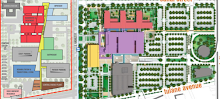
The colors are a bit more appealing, and it appears from all the hopeful green blotches that the trees won't be moved to a tree museum.  But the revised hospital footprint as of August 18 (thanks to Jonah at Save Charity for getting us up to speed graphically) remains true to the original footprint reported by the Times-Picayune in one key regard: it's replete with parking lots.

Inner city regions are characterized by a certain density, even more so in historic sections of New Orleans.  Demolishing existing homes and businesses to make way for vast expanses of single-level parking lot is not only unwise given the loss of historic structures, but also degrading to residents in this case.  It's salt in the wounds - making way for a hospital is bad enough, making way for a field of asphalt is worse yet.  The property rights of those whose land would be subject to a government taking might get compensation, but is the ends of this planned government taking really a permissible "public use" in the first place - the paving over of multiple city blocks for parking?  And even if it is found legally permissive, is it defensible, generally?

When Constitutional rights are involved, as well as an entrenched popular and legal concept like property, one would think that planners could find a way to concentrate the parking needs of the facility rather drastically and, correspondingly, minimize the need to employ eminent domain.  A quick review of the existing Mid-City neighborhoods that surround the footprint should, one would think, give architects and planners an idea that the aesthetics endemic to Mid-City are a little different than, say, suburban Iowa.  Apparently, all the ruckus that preceded the Section 106 meeting back in August fell on deaf ears, however.

Sunday, September 27, 2009