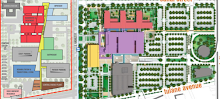
"BATON ROUGE -- Construction was completed last July on the new, highly touted clinical research building at LSU's Pennington Biomedical Research Center.
One year later, only the first two floors of the four-story building are occupied, and there are no set plans to open the rest of the $25 million facility.
Donna Ryan, Pennington associate executive director for clinical research, tells The Advocate the center's struggles are largely invisible to the general public."
I don't know what it's going to take before the public wakes up and realizes that pouring state funds into biomedical facilities, especially right now, isn't going to create some sort of magic mill that just cranks out wealth, jobs, progress, and sugary treats.
The problems with Pennington should stand as a huge red warning flag for both the proposed UMC, which is also unsustainable as currently envisioned, as well as many aspects of BioDistrict New Orleans. We should be skeptical of any proposed panacea.
Monday, July 11, 2011


The second house in the camelback trio goes down

"And you tell me...

...Over and over and over again, my friend...

...Ah, you don't believe...

...We're on the eve of destruction."
Razed, Two Views of a Vacancy

Another house, this one in the 300 block of S. Roman Street, is gone, the one visible on the left in this shot.


Sunday, July 10, 2011
AP's take on the HUD app. withdrawal
Here.
Note that the account could be read to show Senator Vitter's opposition...as the cause of the UMC decision to withdraw.
Note that the account could be read to show Senator Vitter's opposition...as the cause of the UMC decision to withdraw.
Going Dark, Working on a Sunday

The camelback at 1928-30 Cleveland Avenue proceeded through heavy salvage today, its floor joists have been cut out and the building, one of the camelback triplets, is headed for demolition.
As always, I'm glad that Willie White's crack salvage crew is extracting as much value from the building in the form of architectural elements...but as always in the UMC Footprint, there's no reason this house should be demolished. Here's a shot with more detail of the interesting brackets.

The Hubris of Bobby Jindal
"The governor says test pilings will be going in the ground soon and, as far as he is concerned, nothing is going to stop this project."
Reality, Governor, reality. Just remember that.
Remember the over 100 lawsuits underway involving expropriations of parcels in the UMC site made by the State of Louisiana through the LSU Board of Supervisors and the Office of the Governor.
Remember the lack of $400 million in necessary financing to build the first phase of the hospital alone - which makes talk of certain future expansion highly speculative and fanciful. Remember that the failure to pursue HUD mortgage insurance will likely increase the cost of filling that gap given the signals it will send to the private market.
Remember how far behind New Orleans is when it comes to the race to build top-notch biotech infrastructure as you spout more Birmingham-envy - and how the city and state will likely have to spend exponentially more to get into any position to compete at this point.
Remember the unsustainable estimated $100 in annual operating costs in the form of a state subsidy - and the ramp-up costs, and whatever legacy debts need to be taken on.
Remember, too, that in admitting there is still no business plan - and there won't be one for months - you're illuminating just how irresponsible you really are by pushing for demolitions to continue before there's a feasible plan in place.
Friday, July 8, 2011
Thursday, July 7, 2011
Circling the Drain

Today's been an incredibly busy day. I haven't even made it to the Footprint.
But here are two shots from last evening. They show the two other camelbacks in the set of three on Cleveland that were losing parts of themselves to salvage...a sure sign that they, too, were circling the drain of demolition...and very well may be gone by now.

Times-Pic on the HUD App Withdrawal
Here:
The University Medical Center governing board has abandoned its effort to secure federal mortgage financing to back any debt necessary to complete a new teaching hospital near downtown, and a UMC consultant said the project could be headed for further changes that he did not detail.
This is the critical part - what private investor will now touch the project?
The letter appears to confirm what some UMC leaders, state authorities and critics of the project have chattered about for months: Any borrowing necessary to complete the hospital will almost certainly have to come from the private bond market, potentially at junk bond rates. It also suggests that UMC could have to sell bonds to investors who know the project, for whatever reasons, did not win federal backing. HUD mortgage insurance, considered the gold standard of financing not-for-profit hospitals, would allow much lower rates, meaning considerably lower debt payments, because investors would be assured payment by the federal treasurer if the hospital defaulted.
All of those considerations are part of the billion-dollar question: What scope and services should a public teaching hospital provide -- and with what level of taxpayer support -- to be financially viable?
Governor Jindal and the Mayor both tried, in full defensive mode, to paper over the development at a press conference this afternoon when questioned by a reporter. It was all glittering generalities and bulling forward despite realities. And the Mayor made a special point, once again, of reminding people that, in his mind, retrofitting Charity Hospital is off the table.
Even though the ever-swirling, still uncertain facts would indicate otherwise.
BREAKING - UMC Withdraws HUD Mortgage Insurance Pre-Application
This is a severe problem for the proposed UMC:


Fundamental Questions about the UMC
These are such simple questions, that they've been somewhat overlooked by far too many in the ongoing fight over the UMC hospital:
Is the UMC (University Medical Center Management Corporation Board) - created by the State of Louisiana to secure funding for and operate the proposed University Medical Center (and formerly the EARL K. LONG MEDICAL FOUNDATION, INC.) - a public or private entity for purposes of determining whether a government taking involves a legitimate "public purpose"?
Upon legal challenge, would expropriation of various private properties in the LSU Footprint by the LSU Board of Supervisors be found valid under the Louisiana State Constitution?
I don't know that these questions have truly been answered. With dozens of UMC property-related lawsuits underway, perhaps we'll slowly see answers emerge. Or perhaps we'll learn sooner. Feel free to opine in the comments.
Tree Treatment

Hurricane Katrina devastated the extensive, mature tree canopy of New Orleans. An estimated 100,000 trees were lost in the city as a result of Katrina and Rita together, damaging or eliminating at least 70% of the city's tree canopy.
Thus, it was somewhat depressing to watch crews chop down numerous large, mature live oaks and other trees in the VA Footprint.
And now, workers continue to chop down trees in the LSU Footprint...even in areas that won't necessarily be built upon in the first phase of construction (and it's unclear whether a second phase will ever even come into being - the first phase is uncertain enough). The photo above shows a swath of downed trees that fell to the machinery yesterday.

Conversely, the photo at the top of the post shows extra measures being taken with the remaining live oaks in the VA Footprint. The tree guards were installed in recent weeks to prevent damage to the trees as construction gets underway. I must say that Clark/McCarthy, the partnership that oversees actual construction in the VA Footprint, now that the VA itself controls the site, has shown itself to be more conscientious in its efforts to head off and mollify concerns than just about any other contractor that I've encountered inside the footprint. It's not only the partnership's comments at VA neighborhood meetings, but also in some of its tangible efforts at follow through.
That's my impression from limited experience, but it's worth noting. It's proof that, while the terrible site selection likely won't be reversed, being smart about some of the details of how to proceed with a highly charged, controversial project can impact the level of inflamed public opposition.
Wednesday, July 6, 2011
Next?

The board had been taken off the door at this camelback at 1932-34 Cleveland Avenue in the LSU Footprint as of this morning...right next door to the sister house that was demolished yesterday...
Someone
slaps back.
And makes some good points with respect to a recent letter to the editor of the Times-Picayune.
And makes some good points with respect to a recent letter to the editor of the Times-Picayune.
Keep in mind
As I continue to harp on the lack of full UMC financing - and the prospect of over a hundred million dollars annually in required state taxpayer subsidy - I hope readers will keep this in mind:
"Truth in Accounting: Louisiana’s state financial burden even worse than California’s
NEW ORLEANS, La. – The Institute for Truth in Accounting’s state ranking for assets relative to liabilities, released this week, finds Louisiana to be the second most indebted state in the South.
Despite a balanced budget requirement, Louisiana has still managed to acquire $21 billion more in liabilities than it has assets to offset them. That equates to $16,800 per taxpayer, even worse than California’s $15,100. In the South, only Kentucky surpasses Louisiana with $23,800 per taxpayer."
Concerns about the ability to finance initial construction of the UMC - and sustain its operations over time - are not mere chimerical roadblocks raised solely to slow the project. They're genuine concerns based on systemic fiscal issues that the state faces moving forward. And the state's inability to fund the $15 million necessary to fund the completion of the Cancer Center across Tulane Avenue should be giving reasonable folks pause.
The LSU Footprint forecast at this point still looks very much like a vacant 37-acre site with a slight chance of building.
See any watering going on?
1936-38 Cleveland Avenue was demolished yesterday in the LSU (UMC) Footprint.
Here's what the house looked like a few weeks ago, the one on the far right in the series of three camelbacks:

So much for that

In the provision above, you see that the Programmatic Agreement (PA) that governs the LSU/VA site preparation process required the State of Louisiana (Facilities Planning and Control) to notify the head of the Advisory Council for Historic Preservation (a federal entity) that a funding stream for design and construction had been identified and a business plan has been approved for the proposed UMC hospital before demolitions could proceed.
Well, the notice was sent and received, rather perfunctorily...months and months ago. And yet today we know that there is no business plan in place (as proof, Chairman Yarborough of the UMC Board must get one to the legislature by September of this year, I believe) and over $400 million in necessary financing for the construction of the UMC is not in hand.
This particular PA provision, designed to avoid the needless destruction of an entire neighborhood in a national historic district should the state fail to get all of its ducks in a row, utterly failed in its purpose. If any house moving does occur in the UMC site, it will be due to efforts entirely outside the PA.

While Charity Hospital sits empty with no concrete plans (the city, at one point a month ago, told BioDistrict New Orleans to back off in its efforts to acquire the complex), the neighborhood in the LSU Footprint has been largely demolished at this point, and the funding and business plan issues still have not been resolved. That's the sort of thing that leads one to mistrust the state - and just about any federal government agency that's had its hands in the hospitals project.
It may have looked fine on paper. But we've seen how things have played out.
Tuesday, July 5, 2011
Despite talk from state, others, demolitions continue unabated in LSU Footprint
1936-38 Cleveland Avenue looked like this, reduced to rubble:

and
220-22 S. Prieur Street had been erased.
Both were demolished as of the end of the day today in the proposed site of the UMC.
They were both great, intact, structurally sound, well-kept, recently occupied examples of New Orleans architecture, modified camelback variations that are endemic to this city.
It would take an act of unpardonable stupidity and callousness to demolish these buildings when the ostensible reason for demolition remains a proposed project without adequate financing or a business plan. It's an action that the State of Louisiana, LSU Board of Supervisors, and the City of New Orleans, as well as the contractors and subcontractors involved, chose to take.
Interestingly, the sub-contractors demolishing 1936-38 Cleveland were not watering down the demolition as the machinery tore through the piles of debris shortly after 6 p.m. this evening. Someone has video of that, and I'd imagine La DEQ would be interested.
And if, as I suspect, the crew demolishing the building works for Midwest Missouri Contractors, it's not clear that the company is licensed to do business in Louisiana, per a search of the Louisiana State Licensing Board for Contractors.
If someone has information to the contrary, send it along. But those are some interesting tidbits.
Friday, July 1, 2011
More

This building, part of the Blood Center complex in the UMC Footprint, fell to the machinery yesterday.
A good deal of green space surrounded the building - except for one house that held out against the Blood Center's push to acquire the entire block in years past, as former residents of the UMC have pointed out. It was not fully utilized. And now the UMC is, in turn, causing that building and the entire block to be cleared.
Interestingly, the one house on Palmyra that held out, already demolished, shows up on FEMA's "Zombie Demolitions" list - it's one of the 919 demolitions that FEMA is set to fund now that Mayor Landrieu has revived the demolition program Mayor Nagin halted some years ago. There was one other marginal structure on S. Roman that was on the list as well. The Preservation Resource Center is tracking the list, and here's a map showing the two dots in the UMC Footprint, both already demolished.

Another little "ruh roh"
The state did not allocate $15 million needed to complete the Cancer Research Center, immediately across Tulane Avenue from the UMC Footprint.
That does not bode well for the UMC - it shows the danger of proceeding without having all of the financing issues worked out for a major project involving state funds. Or, even if they are worked out, it shows that a project that leans on state funding is still very much subject to the inherent vicissitudes of that source.
I'm not mentioning this because I'm opposed in some way to the Cancer Research Center - unlike the proposed UMC, it's reflective of the need to build dense, vertical construction that reflects its urban context and avoids destroying an excessively large part of the urban grid. I'm merely pointing out this "canary in the coal mine" example...to show how difficult the financing picture remains.
Demolished Yesterday
Here's a view of one more demolition, seen from a vantage point that permits a foreground view of the great 3-bay shotgun house at 262 S. Galvez Street.

The two-story house in background, in the 2100 block of Palmyra, was not historic and was demolished yesterday. Like many of the residences in the UMC Footprint, however, it was occupied until only recently, - and not blighted.


The two-story house in background, in the 2100 block of Palmyra, was not historic and was demolished yesterday. Like many of the residences in the UMC Footprint, however, it was occupied until only recently, - and not blighted.

Subscribe to:
Posts (Atom)